Wednesday, February 15, 2023

Homily: The Sixth Sunday after the Epiphany [February 12, 2023] St. Alban's, Westwood


            Those of us who viewed this week’s State of the Union address saw a number of angry outbursts during the speech. Legislators repeatedly yelled at the president as he spoke. While these displays were disturbing, they were not necessarily surprising. Over the past decade or so much of what we hear and see in public behavior seems to be nothing more than unmitigated rage.

            The day after the speech, a longtime friend and I went for a bike ride and, during a break for coffee, talked both about the angry behavior and remembered the movie Network the great film from 1976. It was written by Paddy Chayefsky, and it satirized the world of television. You may remember the signal moment from that film when newscaster Howard Beale, played to perfection by Peter Finch, goes on national television and says:


All I know is that first you've got to get mad. You've got to say, 'I'm a HUMAN BEING . . .My life has VALUE!' So I want you to get up now. I want all of you to get up out of your chairs. I want you to get up right now and go to the window. Open it, and stick your head out, and yell, 'I'M AS MAD AS HELL, AND I'M NOT GOING TO TAKE THIS ANYMORE!' 


Now that’s a bracing speech, but what happens next is both hilarious and scary: apartment house windows open, and people lean their heads out over their fire escapes and yell in unison: “I’m mad as hell and I’m not going to take this anymore!”

In 1976 this scene became what we would later come to call a meme, and “I’m mad as hell and I’m not going to take this anymore!” caught on as a catch phrase. We all thought it satirical and bizarre. Who knew that, 47 years, later, uncontrolled rage would become the dominant mode of our public life?

This ritualized expression of rage fit the moment perfectly. The 1970s were the time of self-actualization and “getting in touch with your feelings”. It became a truism of the time that anger was, in fact, a good thing and that the church had squelched our emotions by insisting that we all try to be nice at all times. I was in seminary in the early ‘70s and found myself in quite a few encounter groups. It was almost a matter of faith in those days that expressing your anger was the first step on the road to personal and emotional authenticity.

Forty-odd years later, it appears that even if authenticity is a virtue, we might now be experiencing too much of a good thing. Everybody in this society seems to be either enraged, affronted, or aggrieved. “I’m mad as hell and I’m not going to take this anymore!” is no longer a satirical catch phrase. It is the slogan of the 21st century: congressional outbursts; mass shootings; driving cars into parades. The list is depressing and endless.

Our Gospel for this morning [Matthew 5: 21-37] continues our ongoing engagement of the Sermon on the Mount and begins with Jesus’s remarks on anger. He also discusses adultery and divorce in this section, but the anger portion is the largest, and in it he says essentially three things: first, “if you are angry with a brother or sister, you will be liable to judgment”; second, “when you are offering your gift at the altar, if you remember that your brother or sister has something against you, leave your gift there before the altar and go; first be reconciled to your brother or sister, and then come and offer your gift”; and third, “come to terms quickly with your accuser while you are on the way to court with him.” 

In other words: don’t be angry, be reconciled to your sibling, and come to terms with your adversary. These are counsels of moderation. In the past decades they have been heard as a kind of schoolmarmish raining on our collective emotional parade. In the light of both September 11, 2001 and January 6, 2021 they seem like exceedingly good advice.

I’ve spent much of the last month reading Cormac McCarthy’s pair of new novels, The Passenger and Stella Maris. The plots are too complicated to go into here, but near the end of the second book a character discusses the connection between grief and anger and says this:

I know that you can make a good case that all of human sorrow is grounded in injustice. And that sorrow is what is left when rage is expended and found to be impotent. [Cormac McCarthy, Stella Maris, p. 164]

When trying to understand anger, it is helpful to explore the connection between sorrow and rage. Indeed, if you remember the old “feelings wheel”, another relic of the late 20th century, you’ll know that anger and sorrow were always placed very close to each other. One of the things I learned over years in therapy was how my own anger was often an expression of grief over loss—loss of a person, loss of control, loss of something I could not name. My anger did not come out of the blue. It came out as an expression of something I could not adequately give words to, much less understand.

Now it doesn’t take Sigmund Freud to connect all of the public expressions of anger we see in the world today to what might be underlying experiences of grief. Some are angry that they have lost power, status, and prestige. Others are angry that they continue to be victimized by forces beyond their control. Still others lament the predictable yet tragic costs of being alive—the death of loved ones, the decline in one’s physical faculties, the simple fragility of being human. It is easier—and more socially acceptable, particularly for men—to get angry than to cry. Sorrow often presents itself as rage.

When Jesus tells us that “if you are angry with a brother or sister, you will be liable to judgment”, I don’t think he is telling us not to feel or experience anger. Just as in last week’s Gospel he called us to a “higher righteousness”, I believe that today his call is to a deeper acknowledgment of what we actually feel. His two injunctions—to leave our gift at the altar and to make peace before we take our sibling to court—these two warnings ask that we stop in our tracks and think about what we are doing.

It won’t come as a surprise when I say that reflection and introspection are not much on display these days. As our culture speeds up, we tend more and more to act before we think. You may have seen the video and followed the story of the man in the black Tesla who terrorized other motorists on L.A.freeways earlier this year. In stop and go traffic he would get out of his car and bash other vehicles with a pipe. After he was arrested it became known that he has a long history of interpersonal violence. [“Inside a Tesla driver’s alleged ‘reign of terror’ on L.A. freeways and violent past”, Los Angeles Times, February 1, 2023] The striking thing about all the accounts is the way he would go from 0 to 120 on the rage meter instantly and begin hitting people without even thinking about it. I think many of us behave similarly at the computer keyboard, or indeed around the house; perhaps not physically, but certainly verbally and attitudinally. Our first, and easiest response to something which challenges us is to get angry. “I’m mad as hell and I’m not going to take this anymore!” has become our default response to almost everything.

When Jesus tells us to drop our offering and be reconciled, or to think twice about taking our neighbor to court, he is not asking that we deny whatever righteous feelings of anger we might possess. There is a real difference between righteous anger and reactive rage. We are always justifiably outraged by oppression, injustice, and violence. Jesus is asking only that we become more self-aware and try to understand what our anger is really about. Jesus is countercultural in many ways, but perhaps mostly so because he really knew who he was. He knew, accepted, and loved himself and was therefore able to know, accept, and love others. In today’s teaching to his followers—not only those around him on the mountain but you and me, here today—he asks simply that we ask ourselves what it really is we’re feeling when we explode in rage. Before you grab that pipe or hit send on that social media post, think about what is really going on with you. Is it really prophetic anger, or is it a kneejerk expression that disguises grief over a loss you cannot name?

“I’m mad as hell and I’m not going to take this anymore!” If you do remember the movie Network, you’ll also remember that Howard Beale’s rage finally drives him insane. That’s what happens when our world inside is not aligned with what is happening around us. Before we express our anger, let’s stop and think what it might really be about. In so doing we will be taking a step in the direction of that personal authenticity and higher righteousness that Jesus exemplified and asks that we do our best to live into as well. Amen. 


Sunday, February 5, 2023

Homily: The Fifth Sunday after the Epiphany [February 5, 2023] St. John Chrysostom, Rancho Santa Margarita


            A little self-introduction is probably in order. I’m Gary Hall, a priest for over 46 years in this diocese and elsewhere. I retired in 2016 as dean of Washington National Cathedral, and I’ve also served in my time as seminary dean, parish priest, and English teacher, and my wife Kathy has been with me every step of the way. I’m a longtime friend of our bishop and your former vicar, John Taylor, and I’m a relatively new colleague of Linda Allport, who shares leadership with me at Bloy House, the diocesan theological school. My wife Kathy and I are happy to be with you this morning, and I know you eagerly await the arrival of your interim vicar in a few weeks.

            You at St. John’s begin a leadership transition right in the middle of the season of Epiphany, a time when the church celebrates and reflects on how we manifest God in the world. The Greek word epiphany literally means “manifestation”. The season observes the manifestation of God’s glory first in Jesus, then in the church, then in the world, then in us. It seems we cannot talk about God’s glory without finally mentioning ourselves.

            Today’s Gospel [Matthew 5: 13-20] begins with a commonly misunderstood saying from Jesus. “You are the salt of the earth.” Now I don’t know about your family, but in mine we used the phrase “salt of the earth” to describe people who were, well, pretty average, or at least not special. “She’s the salt of the earth” was probably not a fashion-forward compliment back in the day.

            But when, in Matthew’s Gospel, Jesus tells his companions they are the “salt of the earth” he is saying almost exactly the opposite of our common understanding of that phrase:

You are the salt of the earth; but if salt has lost its taste, how can its saltiness be restored? It is no longer good for anything, but is thrown out and trampled under foot. 

             It’s clear, when you listen closely, that Jesus uses salt to denote something that gives flavor to the otherwise dull foodstuff we might apply it to. In his 2003 bestseller Salt, the author Mark Kurlansky tells a fascinating tale of the role that salt has played in human society. It was prized not only for its savor but also its use as a preservative. And in ancient Israel salt even had a religious role. As Kurlansky explains, 


Salt was to the ancient Hebrews, and still is to modern Jews, the symbol of the eternal nature of God’s covenant with Israel . . . Loyalty and friendship are sealed with salt because its essence does not change. [Mark Kurlansky,Salt, p. 6]


            When Jesus describes his followers as “salt of the earth” he therefore must mean that they are both precious and special. Just as salt is necessary for human life, Jesus’s companions are vital to the life of the world.

            The same holds for his next comparison:

You are the light of the world. A city built on a hill cannot be hid. No one after lighting a lamp puts it under the bushel basket, but on the lampstand, and it gives light to all in the house. 

            Those of us of a certain age remember Ronald Reagan’s use of the phrase “city on a hill” to describe the United States. It is a term he borrowed from the 17th century Puritan John Winthrop, who in turn took it from this Gospel. When Jesus tells us that we are the “light of the world”, he means that our job is to light the world up just as God has done both in creation and in the life and ministry of Jesus. 

            Okay; these are interesting comparisons. What do they mean for you and me? 

            While it is true that Jesus is concerned with each of us as individuals, he also cares deeply about the group that he has gathered around him. When Jesus addresses the crowd in this passage, he uses the word “you” in its plural form. So yes, we individually and collectively are the salt of the earth and the light of the world. Salt without savor is useless. Lamps under bushels don’t shed much light.

            Why do these distinctions matter? For a couple of reasons.

            When we say that God created us in God’s own image, we mean that each human being represents some unique aspect of the divine. When we say that human beings are precious, we also mean that both together and separately we show forth some aspect of God that is revealed nowhere else. One of the problems we have in the church is that we tend, in Anglicanism’s greatest theologian Richard Hooker’s words, to “overpraise the sacred”. It’s not just that the Bible and church and the sacraments are holy. It’s also that we ourselves are holy. We are holy because God is holy. We are holy because, each and together, we embody some aspect of God.

            What Jesus is saying today, then, has real implications for us both separately and as a community. We are the salt of the earth. We are the light of the world. Our task, as followers of Jesus, is to claim and live out that aspect of the divine image that we alone embody as our unique contribution to God’s work in the world. Your task, as a follower of Jesus, is to know and accept yourself in all your wonderful particularity. God doesn’t need you to try to be someone else. God needs you to be who you are.

            If you think I am overstating the case here, hear again two things Jesus says at the end of today’s Gospel passage:


First,


Do not think that I have come to abolish the law or the prophets; I have come not to abolish but to fulfill. 

And,

For I tell you, unless your righteousness exceeds that of the scribes and Pharisees, you will never enter the kingdom of heaven.” 

            Remember a while back I quoted the author of Salt saying that salt was sacred to ancient Hebrews because it symbolized “the eternal nature of God’s covenant with Israel”.  Accepting our nature as both salt and light is not just good lifestyle advice. Accepting our nature as both salt and light is, in some sense, our sacred duty. The people who challenged Jesus, the “scribes and Pharisees” in Matthew’s language, were religious conformists. They represented that unfortunate tendency we all have to make people march in religious lock step. They were scandalized by Jesus because he and his companions lived free lives which challenged that conformity and looked suspiciously like a violation of Jewish law.

            But what Jesus shows here is that nonconformity, living not in imitation of others but out of what Thomas Merton called one’s “true self” is in fact the highest kind of faithfulness there is. Living this way is actually a fulfillment of, not a deviation from, God’s commandments. That’s why Jesus says that we who follow him are called to a higher righteousness. It’s easy to follow a rule book. It’s harder to live authentically. But living and acting out of one’s true and deepest identity are what following Jesus is all about.

            This is true for you and me and all of us who seek to follow Jesus. We are each called to know, accept, and love ourselves as we are, and to use the actual gifts we have to embody our true selves as we engage our families, our work, our church and our world. And what is true for us individually is also true for us as a church community. God doesn’t need St. John Chrysostom to look and act like any other Episcopal church. God needs this congregation to live into its real, beloved identity as it is—with all its joys and gifts, with all its quirks and complications.

            You all are now at the beginning of a transition in clergy leadership. These moments can be fraught, because so much of a congregation’s identity can be caught up in the identity of its leader. One of the drawbacks of our tradition is that we can be a bit “priest-centric”. As you begin this interim time between vicars, remember Jesus’s words to his companions. You are the salt of the earth, the light of the world. You have something as a church to offer that no other church has. Your job in these months is to talk and listen to and love each other, to rediscover what it is that makes you both salty and illuminating, and to imagine how you might bring savor and light to the people both inside and outside these walls.

            This time may seem like a bummer, but it is really sacred time. Use it to discover again what makes you unique. In doing so, you will be fulfilling God’s purpose and stepping up to that higher righteousness that Jesus both offers and demands of those of us who follow him. You are the salt of the earth. You are the light of the world. Accept it. Claim it. Live it. And, most of all, enjoy the discoveries you’ll make on this wild and sacred ride. Amen.

Tuesday, January 17, 2023

Homily: The Second Sunday after the Epiphany [January 15, 2023] St. Alban's, Westwood


            One of the many connections I have with your former rector, Susan Klein, is that she followed me as vicar, then rector, of St. Aidan’s Church in Malibu. For many years Susan and I have been good friends, and we are both members of a clergy colleague group. Over the years we’ve had occasion to discuss our time in Malibu, especially the revolving door of “seekers” who come into the church, look around for a while, and then leave. After my stint in Malibu I served for many years at All Saints, Pasadena, and part of my job there was to oversee the Covenant Class, an eight-week course for newcomers that brought people into the life of the parish. What we learned there was that, after a few weeks, about half the people who had enthusiastically joined the church just drifted away to try out another faith community.

            My experiences in Malibu and Pasadena led me, over time, to understand that many people are spiritually restless and are driven to explore a number of religious traditions, Christianity among them. As Susan once said, “The problem isn’t that people today don’t believe anything. The problem is they believe everything”, putting Christianity on an equal plane with belief in Astrology, Crystals, and Numerology. Many people come toward us, but only some of them will stick with us.

            Today’s Gospel [John 1: 29-42] brings this issue into focus. Two disciples of John the Baptist are seeking the Messiah when they encounter Jesus:

The next day John again was standing with two of his disciples, and as he watched Jesus walk by, he exclaimed, “Look, here is the Lamb of God!” The two disciples heard him say this, and they followed Jesus. When Jesus turned and saw them following, he said to them, “What are you looking for?” They said to him, “Rabbi” (which translated means Teacher), “where are you staying?” He said to them, “Come and see.”


These two disciples (Andrew and one unnamed) are, like modern seekers, restless. They make the move from John the Baptist to Jesus without missing a beat. They are ready to follow anyone who might offer a new hope of healing and peace.

What I find interesting in today’s gospel is the neat irony revealed in what happens next:

They came and saw where he was staying, and they remained with him that day. It was about four o’clock in the afternoon. One of the two who heard John speak and followed him was Andrew, Simon Peter’s brother. He first found his brother Simon and said to him, “We have found the Messiah” (which is translated Anointed). He brought Simon to Jesus, who looked at him and said, “You are Simon son of John. You are to be called Cephas” (which is translated Peter).

Andrew and his colleague have been seeking the Messiah. It turns out that, all the while, the Messiah has been seeking them. They have expended a lot of frenetic energy looking for God. It turns out that God already had them in sight.

We talk a lot in our culture about “spiritual journeys” and “seeking”. Perhaps the wisdom of this story from early on in John’s Gospel has to do not with looking but with being found. 

There has been a lot of talk this week about Prince Harry’s new autobiography, Spare. From what I gather, it’s an autobiography filled with many grievances. I was intrigued when Patti Davis, the daughter of Ronald Reagan, wrote an op-ed in The New York Times last Saturday called “Prince Harry and the Virtue of Silence” [“Prince Harry and the Value of Silence”, New York Times, January 7, 2023]. As the daughter of an American president if not a king, Patti Davis knows a lot about what it means to be aggrieved about one’s treatment in a powerful and famous family.

In her article, she says in part:

Years ago, someone asked me what I would say to my younger self if I could. Without hesitating I answered: “That’s easy. I’d have said, ‘Be quiet.’” Not forever. But until I could stand back and look at things through a wider lens. Until I understood that words have consequences, and they last a really long time. 


Now I don’t want to equate this morning’s disciples with the children of a king and president. But there is something a bit frantic about all four of them. The two biblical characters seem agitated. The two modern ones feel aggrieved. They all act out of a lack of confidence in their status as loved children both of fragile human parents and of God. They are looking for something or someone outside of themselves to validate them.

Over the course of their lives I am sure that Andrew and the unnamed disciple learned to relax and let Jesus find them. And given the wisdom on display in her op-ed essay, I will bet that Patti Davis understands that our approach to wholeness is best grounded less in our own complaint than in an openness to what might be coming toward us. I sense that of the four, Harry is still in process and will, perhaps, get there one day.

The disciples were searching for the Messiah. The Messiah was searching for them. What would a person of long acquaintance with the faith say to a seeker? In Patti Davis’s words, here’s the first step: “Be quiet”.

Being quiet is an easier concept to envision than enact these days. So much of our common life is taken up with chatter. It’s not only the hundreds of advertising messages we receive each day. It’s also the amount of what we might generously term “discourse” in social media and other communications forms that assaults us. It seems like we don’t know what we think until we say it. But with everyone talking all the time, who is really taking any of this chatter in? Is anybody listening to any of this?

Early on in our passage, John the Baptist sees Jesus and calls him the “Lamb of God”. In its very earliest days, the Christian community chose the lamb as its symbol. It was only after Christianity became the religion of the Roman empire that the church discarded the lamb and embraced the cross as its brand. It’s easy to understand why. For hundreds of years we were a marginal movement. Suddenly we were the state’s official religion. Think about it: the lamb is a symbol of weakness. The cross is a symbol of power.

When we’re frantically looking around for God, we are often more drawn to power than vulnerability—to the cross rather than the lamb. Andrew and his friend are on the lookout for a Messiah, a king, a representative of power and authority. Instead of a potentate they find Jesus, a very unlikely Messiah. This lamb of God does not proclaim himself. He sees and knows these two by name. Jesus finds these restless seekers in spite of themselves.

A little autobiography here: tomorrow is Martin Luther King Day, and King had everything to do with my becoming a Christian. I was a freshman in college in the spring of 1968, and in high school and college I had read everything that King wrote. But I had never even entered a church building. King was assassinated on Maundy Thursday, and on Easter I went to a church for the first time in my life to try and make sense of his murder and what it all might mean. Martin Luther King’s witness had found me in high school, and in college his death brought me first into a church and gradually over time into the Christian community. Thinking back, I realize I didn’t really have much to do with it. God was looking for me, and found me through the life, death, and witness first of Martin Luther King and then through the life, death, and resurrection of the one he followed, Jesus of Nazareth, the lamb of God.

At the close of today’s Gospel reading, Jesus meets Andrew’s brother Simon, and tells him that from now on he will be called “Peter”.  In almost every language save English, “peter” means “rock”. Even in this first meeting, Jesus sees something essential about Simon’s nature that he brings out by giving him this new name. This story is not only about God’s search for us. It is about the depth of God’s knowledge of who we are at our core. 

If you find yourself on a frenetic search for God, for meaning and hope in your life, your work, your relationships, you couldn’t do better than follow Patti Davis’s advice to Prince Harry. “Be quiet.” God is on the lookout for you, and (one way or another) God is going to find you. God already loves you and knows what you need. All the spiritual flailing around we do will only get in the way of the inevitable deep and lasting connection we all seek.

God will not rest in the search for you. Your job, a hard one sometimes, is to stop, and listen, and be quiet so that you may be found. Amen.


Monday, January 2, 2023

Homily: Holy Name [January 1, 2023] St. Alban's, Westwood


            I am not a big believer in New Year’s resolutions. My skepticism results from my observation that, at least in my case, they have never worked. Whatever success I have had in changing self-destructive habits has not come from the dropping of the Times Square ball on New Year’s Eve. Quitting smoking, losing weight, getting in shape—it’s possible to do these things, but they require more than mere the tick of a clock. Aside from parades and bowl games, there is not much about this holiday for me to celebrate except the switch from one calendar to another.

            But that is not to say that January 1 is an unimportant day. In the Christian calendar this day was historically called the “Feast of the Circumcision”, a term deriving from today’s gospel account of Mary and Joseph bringing the infant Jesus to be circumcised on the eighth day of his life. As in Christian baptism, so in Jewish circumcision, this ritual signified both belonging and identity. Both rites culminate in being given and claiming a name.

When we adopted a new prayer book in the 1970s, we changed the name of today’s holiday from the “Feast of the Circumcision” to the “The Holy Name of our Lord Jesus Christ”. There were good reasons to do this—only half the population will feel a personal connection to the biblical rite of circumcision—but in so doing we’ve lost some of what’s being said by the Holy Family’s obedience to Jewish law. For Jews, circumcision is both an initiatory rite and a sign of God’s promise enacted anew in each generation. In a time of increasing antisemitism it is important to remember that Jesus was Jewish, and that we can only properly understand the meaning of his life, death, resurrection, and ministry in the context of Jewish history and expectation.

            But his name is important, too. “What's in a name?” asks Juliet of Romeo; “that which we call a rose by any other name would smell as sweet.” [Romeo and Juliet, Act 2, Scene 2] Maybe, but you and I know just how important our names are to us. Back when I used to lead retreats and conferences, I discovered the best of all possible icebreaker exercises to introduce people to each other:  ask each person to tell the story of how they were given their first name. You will be surprised that each person’s name has a story, that so much history and meaning are packed into our names. 

            Take the name “Jesus”, for example. Earlier in Luke’s Gospel [Luke 1:31] the angel Gabriel had said to Mary, And now, you will conceive in your womb and bear a son, and you will name him Jesus.” Why that particular name?

            In Aramaic, the spoken form of Hebrew in first century Palestine, the name we translate as “Jesus” was actually spoken as “Jeshua”. And “Jeshua” is the Aramaic version of the Hebrew name “Joshua”. Now for Jews both then and now, the name “Joshua” has religious significance. In the story of the Exodus, it was Moses who led the Jews out of slavery in Egypt through the 40-year period of wandering in the wilderness. But Moses did not lead the people into the promised land. That task was left to his successor Joshua.

            For first-century Jews, the name “Joshua/Jeshua” has saving significance. Joshua led the Jews from slavery to freedom by crossing over the river Jordan into Palestine. As the new Joshua/Jeshua, Jesus leads humanity from death to life beginning with his baptism by John in the Jordan’s waters. What’s in a name? For Jews and Christians, a name means a lot. The name Jesus carries a whole history of sacred meaning. It also carries a promise. By naming the infant Jesus, Mary and Joseph are completing the angel’s promise.  As Gabriel also said to Mary at the Annunciation,

He will be great, and will be called the Son of the Most High, and the Lord God will give to him the throne of his ancestor David. He will reign over the house of Jacob for ever, and of his kingdom there will be no end. [Luke 1: 32-33]


In today’s act of circumcision and naming, God reveals Jesus as the bearer of a promise both for Israel and for humanity at large. This new Joshua will bring us from slavery to freedom, from fear to courage, from death to life.

If this all were only a trip down history lane we would have an interesting take on Jewish history and ritual. But there is much more going on here. In the church we reenact the naming of Jesus on the eighth day of his life in our sacrament of Baptism. Some people are baptized as infants, others as adults. Some people never get baptized at all. Like the Jewish rite of circumcision, the Christian baptism service celebrates both belonging and identity. As followers of Jesus, each of us is given both a community and a name. Like the infant Jesus we are connected now to a story much larger than our own. And like that same child, the precious nature of our identity is revealed for all to see. Our destiny is now bound up with the life, death, and resurrection of Jesus and the community which bears his purpose in the world. And our own individual dignity and worth are now proclaimed by the simple affirmation of our names.

“What’s in a name?” Quite a lot, it seems. Whether you like your name or not, you know how important, over time, it has become. Your name has a story. It has a meaning. It connects you to your family and community. And it uniquely denotes who you are. At bottom Christianity is about two big things: it is about God’s promise of a hopeful destiny for the world, and it is about the unique dignity and worth of every one of God’s creatures. You and I are participants in a story that has a lot of ups and downs but will, in the end, have a glorious outcome. We are important to God not only because of that big story but also each in our own right. We are made in God’s image, known and loved in Jesus, and signified as precious by the bearing of our names. The Holy Name of our Lord Jesus Christ turns out not to be about him only but also about us. We, too, are bearers of God’s love, justice, and purpose in the world, even if we have weird names. 

Several years ago, the British newspaper The Guardian {March 10, 2015)  ran an article with the following headline "High noon for Gary: why is the once-popular name on the verge of extinction." As the copy went on to explain, "The name is dying out, and not even Garys Cooper or Lineker seem capable of saving it. Why do parents hate it now, and what can we do about it?"

For someone named Gary, as I am, this piece was a bristling read:

Parents just don’t like the name any more. Gary reached its peak in the US in the early 1950s, when it was at one time the 12th most popular boy’s name, with more than 38,000 appearing every year. There were even 90 girls named Gary in 1947.

I remember being one of several Garys in my elementary school class. Clearly the name was overused. But over time fashions in names change, and in the last decades we Garys haven’t been the only losers:

In 2013, English and Welsh parents created just 17 Roys, 15 Keiths, seven Kevins and three Traceys. Compare that with 110 Jaxsons, 167 Romeos, 2,211 Siennas, 3,264 Leos and 4,511 Oscars.


            Several of my English friends sent me copies of this article when it ran in 2015. And, if our names were only badges of our fashion, I would find the disappearance of my name cause for alarm. If the name Romeo is on the upswing, it may turn out that Juliet was right. “What IS in a name?”

            I have never met a Romeo. Nor, for that matter, have I met a Jeshua. But, as one who tries to follow Jesus, I have met and come to know and love myriad individual people each of whose names have come to signify a complex human person who bears a unique and precious identity. I am grateful that Mary and Joseph followed the angel Gabriel’s instructions in naming their child Jesus. I am grateful that Jesus has become the name which signifies the love, justice, and compassion of God at work in the world. And I am grateful that the name and story of Jesus have become your name and my name, your story and my story. 

            Know it or not, you and I are now caught up in the Jesus story, and our names signify that his destiny will be ours. “He will be great, and will be called the Son of the Most High, and the Lord God will give to him the throne of his ancestor David. He will reign over the house of Jacob for ever, and of his kingdom there will be no end.” This Christmas news is the gift of Jesus’s Holy Name and yours. Juliet, a fictional character, was wrong. Tiny Tim, another fictional character, was right. God bless us every one! Amen.

Monday, December 26, 2022

Homily: Christmas Day [December 25, 2022] St. Alban's, Westwood


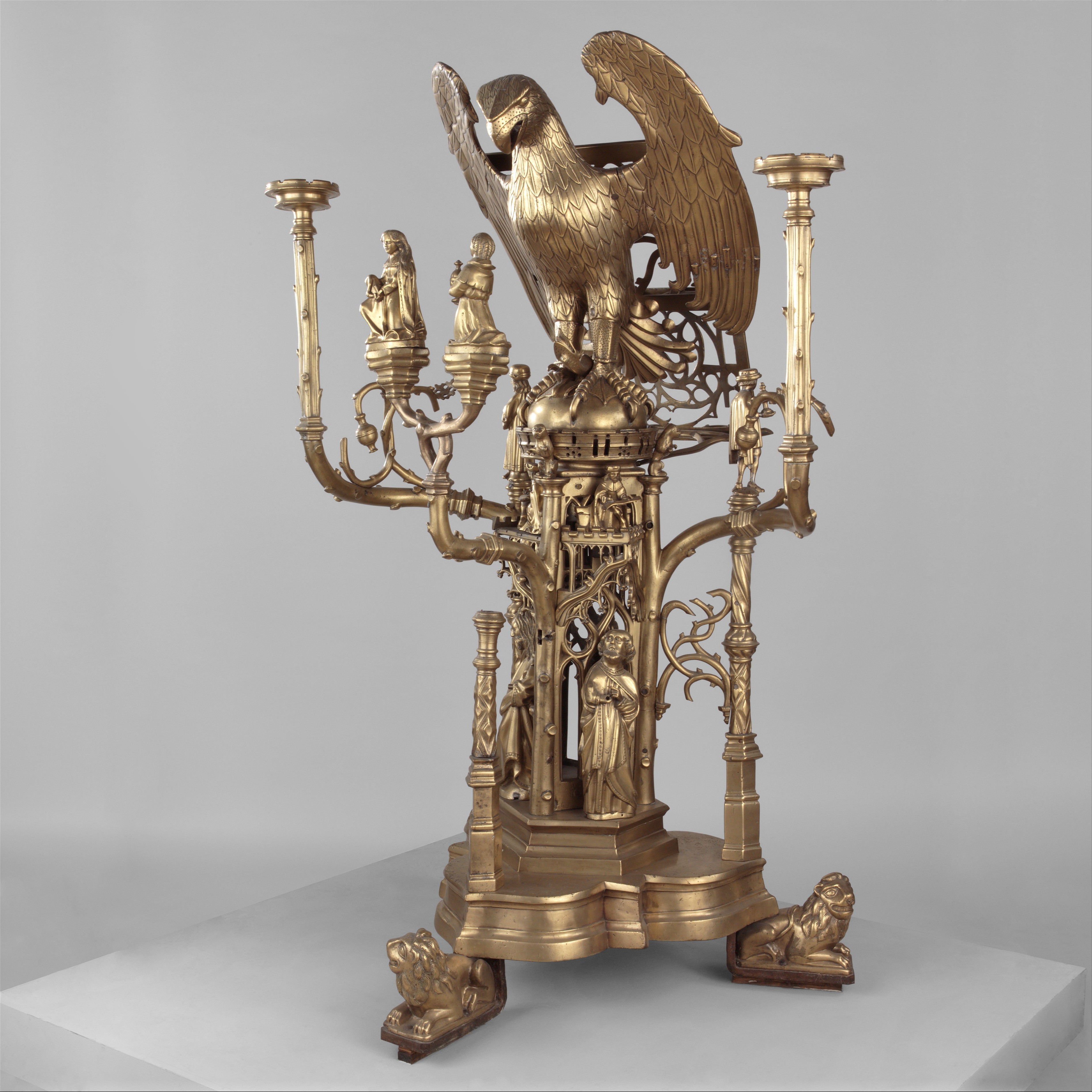
Lectern in the Form of an Eagle, Attributed to Jehan Aert van Tricht (Netherlandish, active Maastricht 1492–1501), Brass, South Netherlandish


Kathy and I have just returned from a month in New York City, where I serve each December as priest-in-residence at the House of the Redeemer, a retreat house on the upper east side. As a lifelong museum junkie, I use my spare time there to frequent the many wonderful collections both nearby and farther afield.

            Last week I decided to revisit the Cloisters, the Metropolitan Museum’s medieval collection at the far northwestern tip of Manhattan. In seminary days I made frequent trips there from Boston, and I have always found it a haven of peace in an otherwise frenetic city.

            This year I saw again many of my favorite pieces in the collection and rested in the indoor cloisters festooned with blooming paperwhites. But I also noticed something I had not seen before: a fifteenth century Dutch brass lectern in the shape of an eagle. Now because we clergy tend to be know-it-alls, you may think we know more than we do. But, to speak truthfully, I have always wondered why so many church lecterns are shaped like eagles. I have asked many learned people over the years, and no one has been able to tell me. Then I read the lectern’s accompanying placard:

Churches usually had two lecterns: a large one like this for reading the gospels, and a smaller one for reading the epistles. The eagle is the symbol of Saint John the Evangelist . . . Eagles often adorned lecterns because the first words of the Gospel of Saint John are, “In the beginning was the Word”.


Case closed! Mystery solved! Another question crossed off my life list. My museum encounter with this gospel bird got me thinking not only about life’s unanswered questions but also about our scripture readings for Christmas Day. They all have to do with words, and words are central to the mystery of God becoming one of us in Jesus.

On Christmas Eve we retell the familiar story of Jesus’s birth in Bethlehem. On Christmas Day the church has always turned its attention away from the manger and toward the larger implications of what we call the Incarnation, literally the “enfleshment” of God in the person of Jesus of Nazareth. The great proclamation of God’s enfleshment in us comes in the opening words of John’s Gospel: “In the beginning was the Word, and the Word was with God, and the Word was God.” Today’s earlier readings prepare us for that world- and life-changing announcement.

All of our scriptures today have something to say about words, speech, song, and proclamation. Here is how Isaiah put it:


How beautiful upon the mountains
are the feet of the messenger who announces peace,

who brings good news,
who announces salvation, 
who says to Zion, "Your God reigns."—Isaiah 52


Then even the psalmist gets into the act:


Sing to the Lord a new song, *
for he has done marvelous things. —Psalm 98


The author of the Letter to the Hebrews gives a more extended meditation on this:


Long ago God spoke to our ancestors in many and various ways by the prophets, but in these last days he has spoken to us by a Son, whom he appointed heir of all things, through whom he also created the worlds. He is the reflection of God's glory and the exact imprint of God's very being, and he sustains all things by his powerful word. —Hebrews 1


And then, of course, come the familiar yet complicated opening words of John’s Gospel:


In the beginning was the Word, and the Word was with God, and the Word was God. He was in the beginning with God. All things came into being through him, and without him not one thing came into being. What has come into being in him was life, and the life was the light of all people. The light shines in the darkness, and the darkness did not overcome it.—John 1


Since the very beginning of our encounter with God in Jesus, we Christians have wanted to talk about Christ as what philosophers call a “speech act”. Jesus is not only a person. He is God’s announcement of the unbreakable connection between God and us. Yes, Jesus was a healer, a teacher, a critic of religious and political power, but he was also something bigger and deeper. He was God’s proclamation about the universe and our place in it.

Just as I had questions about why church lecterns are shaped like eagles, so each one of us wonders how we and God might be related. Over the millennia of human existence, people have developed two primary images of the divine. We might call the first image the Creator of the Universe, the source of being, the ultimate ground of all that is. We might call the second image my saving God, the one who actually cares about me. The daring of biblical religion—first Judaism, then Christianity—is to proclaim that these two are one and the same. For us Christians, the Creator of the Universe and my saving God meet in Jesus Christ. The one at the center of creation actually knows, and cares about, you and me.

This is why we listen to the opening words of John’s Gospel every Christmas Day: to remind ourselves that Christmas is about something really big and deep. It’s about God becoming one of us in Jesus. It’s about what we ultimately mean in the scheme of things. If, as we believe, God actually took on human experience, then your life has real meaning—more than might appear on the surface. If God lived and suffered as you and I do, then our joys and sorrows are more important than we might otherwise think. The point of Christmas is that, in this impossible transaction between God and us, something has happened which changed both us and God. We are connected, now, in ways that need to be announced, proclaimed, and sung to the world.

One of the other things I did while in New York was to spend some time at Holy Cross Monastery in West Park, the home of the Order of the Holy Cross, of which I am a longtime associate. When you go to a monastery you can enter the routine of its prayer life, and three times a day the brothers ring the bells and pray The Angelus, which allows them, with Mary, to place themselves at God’s disposal. The Angelus consists of three sets of three bells, followed by one set of nine bells each accompanied by prayer.

During the first set of three bells, we pray:


The angel of the Lord brought tidings to Mary,

And she conceived by the Holy Spirit.


During the second set of three bells, along with Mary, we pray:


Here I am, the servant of the Lord;

Let it be with me according to your word.


During the third set of three bells, along with Saint John, we pray


The Word became flesh,

And lived among us.


Then, during the set of nine bells, we pray together:


Pour your grace into our hearts, O Lord,

that we who have known the Incarnation

of your son Jesus Christ,

announced by an angel to the Virgin Mary,

may by his + cross and passion

be brought to the glory of his resurrection:

who lives and reigns with you

in the unity of the Holy Spirit,

one God, now and forever. Amen.


Three days in the monastery reminded me of the monks’ wisdom in praying The Angelus three times a day: it encapsulates what Christmas is all about. The birth of the baby Jesus to Mary and Joseph in the Bethlehem barn announces something big and deep about God, the world, you, and me. “The Word became flesh and lived among us.” God has taken on our life, and we are now taken up into God’s. The birth of Jesus at Christmas inevitably leads us, together, to his resurrection at Easter. We matter. And we now share in the ongoing life and purpose of God in the world.

“Sing to the Lord a new song, for he has done marvelous things.” We all carry around so many unanswered questions, surely about problems larger than lecterns and eagles. Christmas is God’s ultimate answer to all the concerns and the lifting of the burdens we share. 

In the beginning was the Word, and the Word was with God, and the Word was God. . . The light shines in the darkness, and the darkness did not overcome it.


Jesus is born and shall be risen, as we too are and will be. You matter. Everyone matters. All will be well. Merry Christmas! Amen.

Monday, November 28, 2022

Homily: The First Sunday of Advent [November 27, 2022] St. Alban's, Westwood


            Today is the First Sunday of Advent, the day which begins the Christian year. It is a shame that the cultural noise of our American holiday season almost obliterates this beautiful four-week moment. Advent is a time of watching and waiting, a time of hope, of expectation, and self-examination. We have turned it into a frenzy of shopping and partying instead.

            Not that there’s anything wrong with buying gifts or seeing friends. But the way we do it gets in the way of the wonderful if strange rhythm of this season. Taken together, the four weeks of Advent prepare us for the coming of Christ. Later in the season we will focus on the approach of Jesus’s birth in Bethlehem. Today, at the start, we look way toward the future, toward, in the words of today’s collect, “the last day, when he shall come again in his glorious majesty to judge both the living and the dead”. Advent on this first Sunday is more about last things than former things. It is about getting ready for the ultimate disposition of our souls.

            When I was in seminary I studied with Krister Stendahl, a great New Testament scholar and future Archbishop of Uppsala in Sweden. When discussing today’s gospel passage, Professor Stendahl said that this day, the First Sunday of Advent, has had a curious history. Over the course of the Christian centuries, churches have used every single liturgical color—purple and blue, yes, but also white, green, red and (you guessed it) even black to represent our perception of how we ought to regard the second coming of Jesus. Over time, the church has been both powerful and weak. If Jesus’s return is good news—if we’re oppressed or suffering—we’ll use white or red. If it’s bad news—if we’re the oppressors or the inflictors of suffering—we’ll use black. When in doubt, purple or blue will do.

            Stendahl also said this when asked about the seeming contradiction between God’s judgment and God’s mercy. “God acts. How we respond to it depends on where we are in relation to it. Some of us will experience God’s action as judgment, others as mercy.”

            Those two gems of wisdom from seminary days come to mind in relation to the gospel passage for today [Matthew 24: 36-44]. Jesus tells his disciples about the “coming of the Son of Man”. Everything will proceed as normal, he says. Then “one will be taken and one will be left”. It is easy to see how generations of apocalyptically-minded Christians have portrayed the coming of the Son of Man as a dramatic, cosmic event. It’s also possible to read this saying as a comment on the unpredictability of how each of our lives will end. One way or another, you and I are proceeding toward a final summing up. When we encounter God and Jesus in that moment, some of us will experience that meeting as judgment, others as mercy. Probably, for all of us, a little of both.

            According to Jesus, this is a final exam for which we can do little to prepare. His advice in the mean time? “Keep awake therefore, for you do not know on what day your Lord is coming.”

            “Keep awake”. I have watched with some amusement and then growing alarm the recent controversy about the word “woke”. I thought it a bit self-congratulatory for the original users of the term to describe themselves as having awakened from the slumber the rest of us endure. And then I thought it entirely bogus for those who objected to the term “woke” to apply it to all who espoused even modestly progressive views. Nobody, I believe, is truly “woke”. As Henry David Thoreau says in chapter two of Walden, “I have never yet met a man who was quite awake. How could I have looked him in the face?

            When Jesus tells us to “keep awake” he is telling us neither to “get woke” nor to hop ourselves up on No-Doz. He is, rather, telling us something about an attitude toward life.  We might also render his words as something like, “Pay attention”. For after all, isn’t paying attention what spirituality is really about? 

            You and I live in a world that is making ever-increasing demands on our attention. American work life has become so invasive as to spill over the bounds of the week and take over what used to be our leisure time. Our devices connect us both to each other and to an endless stream of ads and messages that claim supreme importance. The pervasiveness of these messages makes us behave more reactively than intentionally. They ask that we respond to everything that comes at us without thinking.

            One of the reasons the church has developed the prayer practices it has is simply to hold up for us things to contemplate that we wouldn’t otherwise encounter. When we come together on Sunday, from week to week we hear an array of scripture readings that tell us things we will not get on social media or cable TV. We are asked to listen to those Bible readings because they speak to us truths that can get obscured by the cultural noise which always threatens to overwhelm us. There’s not much room for love, justice, and compassion in our shared cultural pandemonium. We’ll only hear about God’s values if we seek them out.

            I was once on a panel with the late Diogenes Allen, an author who taught the philosophy of religion at Princeton. At the end of the discussion, he told us to remember one thing: “We become what we attend to.” That saying has stuck with me over the years. “We become what we attend to.” If you attend to Tik Tok videos showbiz gossip, they will form your character. If you attend to Jesus, you will over time become like him. I believe that is what Jesus means when he tells us to “keep awake”. In a world dominated by celebrity and power and all kinds of bad values, the way to follow Jesus is to attend to him. Come to church. Read the Bible. Say your prayers. It’s not hard, but it requires the desire to do it.

            Keeping awake, becoming what we attend to: these are what the season of Advent is about. It’s not only, or even particularly, about getting ready for Christmas. Advent is about a stance toward life.  That is what Thoreau meant when he said, “We must learn to reawaken and keep ourselves awake, not by mechanical aids, but by an infinite expectation of the dawn . . .”

            My late friend and mentor George Regas used to say that someone who doesn’t feel the joy and pain of the world has “gone to sleep on life”. It is only when I am spiritually asleep that I can drive by the homeless encampments around Los Angeles and feel nothing beyond annoyance. It is only because I have gone to sleep on life that I can ignore the stories of real suffering and injustice in the news and get distracted by the gossip. It is only because I have gone to sleep on life that I can miss real moments of natural beauty or interpersonal connection because I’m distracted by the intrusive claims of my iPhone.

            Thoreau also said, “To be awake is to be alive”.  He might have been channeling Jesus. On this First Sunday of Advent, we hear Jesus calling us to wake up! Step out of the information glut that engulfs you and pay attention to the people and the world around you. Stop listening to pundits and start listening to Jesus, whose teaching will always point you toward a true appreciation of life in all its mystery and wonder. We have all become sleepwalkers. It is time for us to wake up.

            “We become what we attend to.” As we make our way through this beautiful time of year in California, let us approach December 25 not in a slavish frenzy of consumption but in a watchful, hopeful “infinite expectation of the dawn”. God is always coming toward us. Let us prepare for God’s advent by watching, by waiting, by paying attention. If we are faithful and persistent in redirecting our gaze toward Jesus and the life he offers, we will, as Paul says, “cast off the works of darkness and put on the armor of light”. 

            Wake up! Jesus is coming toward you. Use this time to prepare yourself to recognize and receive him as he approaches. Amen.


Sunday, November 13, 2022

Homily: The Twentiy-third Sunday after Pentecost [November 13, 2022] St. Michael and All Angels, Corona Del Mar


            It is a real pleasure to be with you here at St. Michael’s, this morning. I made my first visit here in the fall of 1976, when fresh out of seminary I served as the late Bishop Rusack’s chaplain. I preached here a few times in the 1990s when my good, longtime friend Peter Haynes was your rector, and your church surprisingly was not struck by lightning even once. And Barbara Stewart (who was made a canon of the diocese by Bishop Taylor at our Diocesan Convention this weekend) and I have long been members of a clergy colleague group together. (Barbara, I’ll show you the secret handshake at coffee hour.)  So I have many ongoing connections with this parish, and I appreciate Louise’s invitation to join you today.        

            I, for one, am deeply glad that the midterm elections are (almost!) over. It got to the point in the days before Tuesday that I was afraid to turn on the television. The cable channels were filled with the kind of pointless prognostications that TV anchors usually reserve for the moments just after earthquakes. “Where was it? We don’t know. How big was it? Your guess is as good as mine.” And then there was the barrage of political ads designed both to enrage and confuse you. It was enough to make you want to go live on a desert island.

The days leading up to and following Tuesday’s midterm elections have felt positively apocalyptic, so we should feel right at home in this morning’s gospel reading [Luke 21: 5-19]. Jesus paints a lurid picture there: wars, insurrections, a thrown-down temple, persecutions, and betrayals. To one who lived and worked in Washington D.C. for several years, this sounds like a normal day in Congress.

            We Episcopalians are very near the end of the church year, a calendar based not on solar or lunar models but on the outline of the story of Jesus. The year begins in Advent as we expect the coming of Christ, and it ends with the revelation next Sunday that Jesus, not the principalities and powers of the world, is the one finally in charge. In between those poles we experience Jesus’s birth, his teaching and healing, his entry into Jerusalem, his conflict with the authorities there, his trial, crucifixion, and death, and finally his resurrection, ascension, and the coming of the Spirit at Pentecost. A lot happens in a year with Jesus, and today we are getting ready to ask ourselves what it all means.

            There seem to be two clusters of ideas in today’s gospel: one describing the chaos of the present moment, the other suggesting how Jesus’s followers should interact with the world. I’d like to say a word about each cluster and then to conclude with a thought about stewardship, which I gather is the focus this morning of parish life here at St. Michael’s.

            Listen again to Jesus:

Nation will rise against nation, and kingdom against kingdom; there will be great earthquakes, and in various places famines and plagues; and there will be dreadful portents and great signs from heaven.

The great 20th century theologian Karl Barth once said that preachers should hold the Bible in one hand and the newspaper in the other. (I wonder what he would have said about Facebook and Twitter.) There are times when the Bible seems hopelessly alien. There are moments when it seems ripped from today’s headlines.

            We live now in a time of dreadful portents and great signs from heaven. It is no wonder that Monday night’s lunar eclipse was hailed by some as an omen about what the next day’s elections would bring: wars and insurrections indeed. The leadup to Tuesday was brutal: horrible negative ads, lawsuits filed contesting votes that hadn’t even happened yet, promises of violence if the election did not go a certain way. We are fortunate that there has been relative calm since Tuesday, but the recounts haven’t started yet.

            Those of us of a certain age have spent most of our lives under a relatively peaceful national and international order. We became conditioned to a long stretch of world peace and bipartisan domestic tranquility. But history and our recent experience teach us that the post-World War II period was a bit of an anomaly. Chaos and contention are more rule than exception. Those who came before and after us have been more conditioned to sustained conflict both at home and abroad. 

            When we listen to Jesus, we should remember that his own time was one of great animosity and tension. Israel was subject to a brutal Roman occupation. And the gospels also witness the internal dissensions within Judaism itself. Jesus was living with, ministering and preaching to, people who were stressed out economically, politically, and even spiritually. They lived, as the King James Bible had it, under the continual threat of “wars and rumors of wars”.

            The first thing we need to hear today is that we should not be misled by our nostalgic wish for a more bipartisan, harmonious time. Sure, it was more peaceful in the 1950s. But that peace was paid for by the silencing and oppression of people who were not white, straight, and male. Relative peace can hide systemic injustice. History is the record of an ongoing struggle between good and evil, justice and oppression, love and hatred. From time to time we may experience a pause in the conflict, but we should not confuse a temporary calm with a lasting peace. 

As much as I dislike the tensions and enmities of the current moment in America and the world, the persistence of the conflict reminds us that people of faith are always asked to engage with the issues of our day. Long as we might to escape into a fantasy of a more civil and harmonious past, Jesus reminds us that there is no safe haven on offer for those who follow him. We will make our way through wars and rumors of wars by remaining faithful to the vision of hope and justice to which Jesus always calls us.

            This first realization cluster suggests a second. Again, in Jesus’s words:  

You will be betrayed even by parents and brothers, by relatives and friends; and they will put some of you to death. You will be hated by all because of my name. But not a hair of your head will perish. By your endurance you will gain your souls.

            Just as the second half of the last century was a time of relative political calm, so the relative security in which we who follow Jesus live, at least in the United States and Europe, can lull us into thinking that it’s easy to be a Christian in a contentious and violent world. Again, history helps us here. The earliest Christians were persecuted by Rome because they refused to accept Caesar as the one with ultimate authority over them. In every subsequent era of world history, the followers of Jesus have found themselves at odds with the values of the prevailing culture in which they live. Our current critique of environmental, racial, and economic violence is another version of Jesus’s critique of the values of ancient Rome and all subsequent authoritarian impulses in world history. If we really get and enact what Jesus is saying about how we ought to live with each other we will always be an irritant to the powers that be. 

            When Jesus tells us, 

so make up your minds not to prepare your defense in advance; for I will give you words and a wisdom that none of your opponents will be able to withstand or contradict,


he is simply telling us not to live through something painful twice. When we worry about something in advance, we experience it both in anticipation and in real time. Once is clearly enough.

            From what I read on your website, today is the day on which St. Michael’s begins its stewardship campaign. I will leave it to others to say in particular why this parish deserves your support. But, given what we’ve heard in the gospel this morning, I would like to leave you with one thought about living in and supporting a Christian community.

            We Episcopalians are fairly worldly as Christians go: we dance, we drink, we even play cards. We are at ease in the habits of the secular world. We do not hand out tracts on the street. We wear our faith lightly.

            Our church’s cultural comfort should not disguise the extent to which we nevertheless hold the world and its values up to the judgment of the gospel. Like Jesus’s earliest followers and Christian witnesses through history, we know deep down that we are not entirely at home in this world. And that is why, even at an unconscious level, we Christians come together and form communities. As much as we love this world, we know we are not entirely of it. We need a place and a community where we can remember and live out who we really are.

            Remembering who we are as Jesus’s followers and living out our true identity in worship, in fellowship, in pastoral care, in service to those who are sick or who suffer—this is why churches exist and this is why you and I who belong to them give them our support. We give to the church not out of guilt but out of gratitude that there is at least one place where we can be who we are and live as God calls us to live.

            The midterms aren’t entirely over, and 2024 is just around the corner. You and I who come together in the church will continue to hear of wars and insurrections. We will continue to come up against the skewed values of the culture we live in. We will continue to be asked to witness to the compassionate values of Jesus. We cannot do that entirely on our own. Jesus promises to be there with us when we come face to face with the forces that would deny him and dehumanize us. He is there with us in the life, worship, and ministry of our parish church. We need our church community more than we know. And it is there for us in ways we can never truly enumerate. That is why St. Michael’s deserves your support. Amen.