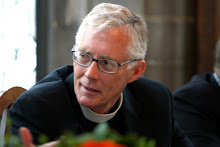
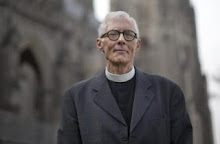
I’m Gary Hall, your new priest in charge, here to see you through the last bit of your rector transition. I don’t really start until New Year’s Day, but I thought I’d give you a sneak preview now so you could begin thinking about alternative ways to spend your Sunday mornings for the next six months. Call it advance warning of what you’re likely to be in for.
You should have received a letter listing some of my credentials. If not, I’ll happily recite them to you at the door. I’m not going to spend a lot of time introducing myself. But I do want to begin by saying what a pleasure it is to be with you this morning as my brief interim here begins. I’ve known many lay and clergy folks at All Saints over the years, and I have long admired your traditions of great music and expansive welcome. I look forward to a stable yet engaging six months with you.
My wife Kathy and I are just back from a month in New York City where I have served for the past seven Decembers as priest-in-residence at the House of the Redeemer, an Episcopal retreat house on the upper east side. Advent in New York City is an intense experience: the lights, the crowds, the store, and yes, the tree. There is so much sensual stimulation there this month that the holiday itself is almost (but not quite) overwhelmed. Speaking as one who grew up partly in Beverly Hills, I’m sure that the scene on Rodeo Drive each December is pretty much the same.
In a way, our shared experience of observing Christmas surrounded by overpowering sights and sounds exactly parallels that of the earliest Christians. Jesus and his followers lived in Roman-occupied Judea (as they called it then), and Rome was very much like 21st century America in the way it projected its power through attention-grabbing spectacles. Every time I go into an Apple Store and see the beautiful hi-resolution images on the screens there, I think to myself: so THIS is what we’re competing with.
Just last Sunday, the New York Times ran an opinion piece in which the columnist Nicholas Kristof interviewed New Testament scholar Bart Ehrman. In it they discuss the world-changing power of Christmas. [“What Would Surprise Jesus about Christmas 2025?” December 20, 2025 https://www.nytimes.com/2025/12/20/opinion/jesus-christmas-religion.html] It’s always been about something more than Santa.
There are many ways in which we Christians have always pushed against the values of the prevailing culture which we inhabit. This was true in Jesus’s day, as Ehrman explains:
The heart of Jesus’ message is that loving “others” means caring not only for family and friends but even for strangers — whoever is in need, whether we know them or whether they are like us. This kind of altruism was not promoted — or even accepted — in the Greek and Roman worlds that Jesus came out of. But it is a view that completely transformed the thinking and ethical priorities of the Western world down till today.
In other words, the Romans persecuted Christians partly because we wouldn’t worship the emperor, but mostly because we persisted in treating the sick, the widowed, the orphaned, the poor, the stranger with compassion and dignity. Our willingness to love and honor everyone regardless of origin or status has always set us apart.
On Christmas Eve we retell the familiar story of Jesus’s birth in a Bethlehem stable. If we listened to it every year with fresh ears, it would shock us. It tells how the One at the center of the universe entered our human life and experience by being born in the poorest and least powerful of surroundings. God does not come as an emperor in a marble palace trimmed with gold. God is wrapped in swaddling clothes and lain in a manger, surrounded by the poorest of the poor, the local shepherds.
As Bart Ehrman reminds us, the Christmas story is not a fairy tale. It relates a powerful truth about our life and its meaning. The story has “power to shape how we think and behave towards others”.
Today, on the First Sunday after Christmas, we heard a different gospel reading: the beautiful prologue to John’s Gospel [John 1: 11-18]:
And the Word became flesh and lived among us, and we have seen his glory, the glory as of a father's only son, full of grace and truth. . . . No one has ever seen God. It is God the only Son, who is close to the Father's heart, who has made him known.
In his own more philosophical way, John is saying what Luke is telling us in his Bethlehem story. The Word has become flesh and lived among us, making God known to us in a manner full of grace and truth. The One born in Bethlehem will grow up to heal the sick, forgive us when we sin, feed the hungry, go to the cross rather than deny God’s universal love and goodness, and ultimately come back to us when raised at Easter. This is a story about God and us. God wants to be connected with us and will not be stopped until we and all creation are at one with each other.
In the 18th century, the English poet Christopher Smart gave voice to the mysterious paradox we celebrate at Christmas. In his hymn, “The Nativity of Our Lord and Saviour”, he gives voice to the power and vulnerability we see joined in the stable and later at the cross and empty tomb:
O Most Mighty! O MOST HOLY!
Far beyond the seraph's thought,
Art thou then so mean and lowly
As unheeded prophets taught?
O the magnitude of meekness!
Worth from worth immortal sprung;
O the strength of infant weakness,
If eternal is so young!
--Christopher Smart, “The Nativity of Our Lord and Saviour, A Hymn”
Christmas is about so many things, and this Sunday gives us the chance to reclaim for a moment the mystery central to our faith.
O the magnitude of meekness!
O the strength of infant weakness
God is alive and at work in our world and in you and me in hidden and surprising ways. The creator of the universe is born in a barn. The Word is made flesh and dwells among us.
We miss the point of Christmas if we fail to see ourselves at the center of it. This is a story about God and us. We are the reason God has taken all this on. Here is the deep truth of the gospel: we matter to the One at the center of creation. We matter to each other. We should take ourselves as seriously as God takes us.
On this First Sunday after Christmas, now that the season’s intensity begins to wane, we can see again what the shepherds saw. Mary, Joseph, and the baby show our human experience at the center of God’s heart. You are as precious to God as the baby Jesus was to Mary and Joseph. The beauty of the season can sometimes distract us from its central truth. Your life has meaning and significance not always apparent even to you. Your life, your struggles, your joys, your sorrows—all those things are important to the One who made and loves us all. Christmas is about God coming to be with and in and for us. This is why Christians have always served others. Every human being reflects the depth and beauty of God—even and especially you. That is the deep truth behind this beautiful season, and it is why we now proceed together to give thanks. Amen.

No comments:
Post a Comment