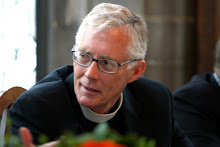
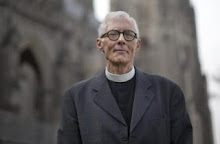
I want to begin by saying both how pleased I am to be here today and just how old this occasion makes me feel. Not only did I know your rector when he was a first year seminarian. I knew your bishop even before he went to seminary. There are some wonderful blessings inherent in a long career in the ministry, but some days I feel like I'm about 106 years old.
And then there's the anomaly of Matthew Butterbaugh being installed as the 25th rector of St. Matthew's. I was the seventh rector of Christ Church Cranbrook, the ninth dean of Seabury-Western, and now I'm the tenth dean of Washington National Cathedral. 25 rectors in Kenosha? You people don't look that mean to me. Since moving to Washington, Kathy and I have come to know and love Mary Garner, the widow of Sanford Garner, a much earlier rector here, and she says you're all lovely people. But 25 rectors? Really? There has to be a story there.
It's probably just as well. In the Episcopal Church we seem to have a prurience for authority. The great Ralph Waldo Emerson said that an institution is “the lengthened shadow of one man" [“Self-Reliance”]. True enough, but Emerson was a self-reliant individualistic Transcendentalist. For us Christians, the church is about community. Indeed, in today's reading from Romans, Paul describes the church as the body of Christ. He means that literally. We are all of us interconnected and part of each other, belonging to something bigger than ourselves. Yet when we talk about parish churches we seem to confuse the rector with the community itself. And here in Kenosha, it doesn't help that your patron saint and your rector now have the same name.
Listen again to Paul:
For as in one body we have many members, and not all the members have the same function, so we, who are many, are one body in Christ, and individually we are members one of another. [Romans 12: 4-5]
As we hear Paul tell us that we are "members one of another", we need to begin our reflection on this new stage in the ministry of St. Matthew's Church with an admission that today is not primarily about the installation of one--admittedly gifted, energetic, and faithful--man. Today is primarily about the ministry of this body in which all of us are members. If you have any doubts about that, think back on our first reading, from Numbers. We didn't hear the part that comes right before the start of that passage, when Moses complains to God in a tone that makes him sound like a kindergartner in need of a nap. He's led the people out of Egypt. They're in the middle of their 40-year sojourn in the desert. Half of the Israelites want to give up and go back to slavery. Moses asks Yahweh for help. And Yahweh takes some of Moses's spirit and puts it on the 70 elders. The point: leadership in the church is not a solo sport. It is a team endeavor. It’s not just individuals who are leaders. Communities can be leaders, too.
So how can this community, how can all of you, lead and serve in the spirit of Moses and the 70 elders? I would begin with the simple thought that self-knowledge is the key to everything. Moses knew himself well enough to see that he needed help. He was secure enough in his identity to ask for it. In Baptism, you and I have been given both a ministry and an identity. Knowing who you are, and knowing that who you are is loved by God and good, is the best place to start. God made each of us unique in God's image. Each of us brings something precious and unrepeatable to the world. If the church is to be a living incarnation of God's mission, then it needs the fullness of everyone's call--not just the rector's--as it enacts that mission in the world. The church doesn’t just need Matthew Butterbaugh to be a great and interesting guy. The church needs all of you to be fully who you are so it can be fully who it is in the world.
In today's reading from Romans, Paul reminds us that God’s Spirit lives in and through us in equal but asymmetrical ways. The Spirit at work in the community is given to everyone, but it is apportioned differently:
We have gifts that differ according to the grace given to us: prophecy, in proportion to faith; ministry, in ministering; the teacher, in teaching; the exhorter, in exhortation; the giver, in generosity; the leader, in diligence; the compassionate, in cheerfulness. [Romans 12:6-8]
In today’s world, knowing who you are and what you can do is no mean achievement. We are all bombarded by thousands of daily messages claiming our attention, and we inhabit a society that commodifies everything we do, urging us take things produced by others into ourselves rather than give voice to the intuitions that come from within. A baptismal vision of the church is radically critical of that consumerist vision of society. It suggests that who you are, what you think, how you feel, what you know about yourself and God—all those intuitions and perceptions are valuable to the common enterprise. So as you begin this new phase of your shared ministry at St. Matthew’s with Father Matthew my prayer is that you strive to make this parish a place where people can bring all of who they are—their hopes, their fears, their sorrows, their joys—to God’s table so that they can be offered up and given to the world. We are all members one of another, and we each have unique and differing gifts. If St. Matthew’s Church—if any church—has a reason for being, it is to celebrate and share those gifts with each other and the world. The true sign of your success in living both corporately and from within is that both St. Matthew’s and Kenosha itself will be the better for your having done so.
And then there’s today's Gospel:
After this the Lord appointed seventy others and sent them on ahead of him in pairs to every town and place where he himself intended to go. He said to them, ‘The harvest is plentiful, but the labourers are few; therefore ask the Lord of the harvest to send out labourers into his harvest. [Luke 10: 1-2]
When we hear this Gospel we are usually so overwhelmed with the news that the seventy appointed by Jesus carried no purse, bag, or sandals—“whoa, not me, Lord, I’m an executive-level Christian!”—that we tend not to hear the first part of the sentence. Listen to this: “he sent them on ahead of him in pairs to every town and place where he himself intended to go.” Did you hear that? “He sent them on ahead of him.” If I hear this right, the Gospel takes the logic of the Numbers reading and carries it one step further. If you and I are the seventy—and I think we are—then it’s not just the case that we’re helping, as that first seventy did Moses. Rather, you and I have been sent on ahead of Jesus to every town and place where he intends to go. Translation: we’re not just helpers. We represent, we prepare the way for, Jesus and his vision of new, transformed, risen life. We are, individually and together, the body of Christ. We are God's enfleshments in the world. That news leads me to two final thoughts and charges I would give to both Matthew and St. Matthew’s as you celebrate your new ministry together.
Charge One: together, you and I together in the church represent Jesus. That means that God has tied up God’s reputation in us. It is vital that the church live with integrity and compassion and urgency because when people look at us they see Jesus, and what they think of Jesus will largely be a product of what they think of us. So the first Gospel charge I hear this afternoon is this: serve each other and the wider community in such a way that when people look at you they will see Jesus. Serve them in such a way that the Jesus they see is the Jesus you know and love and want them to know and love, too.
Charge Two: we all have been sent ahead to prepare the way for Jesus. Our mission is not about us. Our mission is about Jesus and his quest to love, embrace, forgive, bless, and transform the world. You have been given a variety of gifts but the same Spirit. You are called, together, to use those gifts not for the glorification of this parish or its rector but for the glorification of God.
It is God’s mission you and I and your bishop and your rector are about together, and just as it was not all on Moses shoulders to get it right, so it is not all on yours. The good news we all celebrate together this afternoon is this: for some reason none of us can fathom, God has chosen the fragile likes of you and me as the instruments for the healing and transformation of the world. Let us bring all of who we are to that mission. Let us live it with compassion and integrity. And let us give thanks that, when all is said and done, God’s life and justice and blessing and hope will prevail. Amen.
Saturday, October 26, 2013

Sunday, October 6, 2013
Homily: The Twentieth Sunday after Pentecost [October 6, 2013] Washington National Cathedral
Fifteen years ago this month, Matthew Shepard was killed in
Laramie, Wyoming. Three years ago last
month, Tyler Clementi committed suicide in New York City. Matthew was 21 when he died, Tyler 18. Both
young men were gay. We here at the cathedral are taking this weekend both to
remember and honor Matthew and Tyler and to commit ourselves to standing with
and for LGBT youth.
In preparation for our
conversations both Friday night and this morning, I reread Moises Kaufman’s
play, The Laramie Project, an innovative
theater piece created and produced by the Tectonic Theater Project as a response
to Matthew Shepard’s death. Through a series of conversations with the
participants, the play sometimes graphically represents the events of October,
1998. As I reread The Laramie Project I was moved
and shocked all over again, but this time I was particularly taken by the
remarks of a catholic priest, Father Roger Schmidt, who talks about his
participation in a vigil held in Laramie for Matthew. When he was interviewed about his
participation in the vigil, Father Schmidt said this:
And I’m not gonna
sit here and say, “I was just this bold guy—no fear.” I was scared.
I was very vocal in this community when this happened—and I thought,
“You know, should we, uh, should we call the bishop and ask him permission to
do the vigil?” And I was like, “Hell,
no, I’m not going to do that.” His
permission doesn’t make it correct, you realize that? And I’m not knocking bishops, but what is
correct is correct. [The Laramie Project, p. 65]
And then he goes on to say
this:
You think
violence is what they did to Matthew—they did do violence to Matthew—but you
know, every time that you are called [and here he uses a couple of homophobic
epithets I’d rather not repeat in the pulpit] . . .Do you realize that is
violence. That is the seed of violence.
[p. 66]
That’s Father Schmidt, a Roman Catholic priest, speaking in
1998, not in the new, open days of Pope Francis but in the old, authoritarian
days of John Paul. So think about the courage of those words in their own
context. As a person of faith, he responded to a violent hate crime committed
against a young man viscerally and from the heart. He knew what was right, and he did it.
A lot has changed socially and culturally in the last 15
years in America with regard to attitudes toward sexual orientation and gender
identity. But still, as far as young people are concerned, the distance between
Laramie, Rutgers, and the rest of the country is not as far as we might think. Every day, all across America, countless
unnamed boys and girls suffer indignity, humiliation, bullying, and violence,
and they feel that they are in it all alone. And I’m sorry to say that much of
the blame belongs to our churches, which give religious cover to the last
cultural prejudice that we allow to persist in our society: the stigmatization
of a person because of sexual orientation or gender identity. And that cultural prejudice against lesbian,
gay, bisexual, transgendered people persists even in a time when every third
television show features a gay protagonist or next-door neighbor. That prejudice persists because Christian
churches continue to promote it.
Today’s Gospel begins with a
very strange request to Jesus by his companions: “Increase our faith!” they
demand. Step back from that question and think about it. More faith: isn’t that
a weird thing to ask for?
But as odd as the “increase
our faith” question is, Jesus’ reply is even stranger: "If you had faith
the size of a mustard seed, you could say to this mulberry tree, `Be uprooted
and planted in the sea,' and it would obey you.” [Luke 17: 6] Have you ever seen a mustard seed? A mustard seed is really tiny. It makes a
poppy seed look like a watermelon. Jesus
responds to his companions by means of a startling comparison. If you had even an atom of faith you could
work miracles. “You don’t need more faith,” he
seems to be saying. “You just need some faith. Right now you don’t seem to have any faith at
all.”
Now let’s go back to Father Schmidt’s words and think about
them in the context of this faith and mustard seed interchange. There were other Christian clergy in Laramie
who didn’t stand up for Matthew Shepard.
They didn’t want publicly to commit themselves to standing up for a gay
young man, and they most likely were Christians of the “Increase our faith!”
persuasion. “I’d stand with Matt if I
had more faith.” In contrast to
conflict-avoidant Christianity, Father Schmidt seems to understand what Jesus
is talking about this morning. “I’m not gonna sit here and say, ‘I was just this
bold guy—no fear.’ I was scared.” He didn’t
wait until he was fearless to act. He
acted and found that he didn’t have to be ruled by his fear.
I don’t know what I would
have done or said in Laramie, Wyoming in 1998 or in New Brunswick, New Jersey
in 2010, but I hope I would have had the courage of Father Schmidt. I do know
what today’s Gospel calls me (and I believe you) to be doing and saying this
morning. It’s tragic that we still live
in a nation and in a world where the last socially acceptable prejudice is
against LGBT people. It’s tragic that we still live in a nation and a world
where LGBT youth are vulnerable because of that prejudice and the way it
combines with the other stresses of adolescence and young adulthood. But it’s more than tragic—in fact it’s
shameful--that faith communities, especially Christian ones, continue to be
complicit in putting our children at risk and abetting the attitudes that
oppress them, thereby encouraging the aggressors who would subject our children
to pain, humiliation, and violence.
I’m old enough to remember a
time when Christian churches, including our own Episcopal Church, segregated
its churches and actively participated in racism. I’m old enough to remember the ordination of
women movement, when many in our church found ingenious theological arguments
to deny women leadership roles and so promoted sexism. In its wisdom, the church came to its senses and
labeled both racism and sexism as sinful.
And now we find ourselves at the last barrier—call that barrier
homophobia, call it heterosexism. We
must now have the courage to take the final step and call homophobia and
heterosexism what they are. They are
sin. Homophobia is a sin. Heterosexism
is a sin. Shaming people for whom they love is a sin. Shaming people because
their gender identity doesn’t fit neatly into your sense of what it should be
is a sin. Only when all our churches say that clearly and boldly and
courageously will our LGBT youth be free to grow up in a culture that totally
embraces them fully as they are.
Those of us who gather
around this table this morning believe that God has done a new thing in Jesus
and is continuing that new thing in us.
God is breaking down categories and barriers between people and creating
a new humanity in which all the particularities of how we identify
ourselves—racial, ethnic, gender, class—are accepted and blessed as they
contribute to the expanding wonder and diversity of a human race created in
God’s image. The new humanity that
gathers with Jesus at his table come together as we are, secure in the
knowledge that it is good and right to be who we are and to celebrate our
identity in its myriad fullness. It is
not only just OK to be gay, straight, bisexual, or transgendered. It is good to be that way, because that is
the way God has made you. And the
Christian community, the world community, needs you to bring the totality of
your being—including and maybe especially your sexual and gender identity—to
the table.
Young LGBT men and young
women will continue to be vulnerable to the sins of homophobia and
heterosexism, to the violence of hate and fear until we in the church can say
to homosexuals now what it has said to heterosexuals for 2,000 years. Your sexuality is good. The church not only
accepts it. The church celebrates it and
rejoices in it. God loves you as you
are, and the church can do no less.
Only when we find a way
fearlessly to speak just that clearly and boldly to LGBT kids, their families,
their schools, and their communities, will the world be a safe and nurturing
place for the Matthew Shepards and Tyler Clementis of our own day. We don’t need more faith. We just need some faith—faith in a God who is
bigger and deeper and more loving and compassionate than we are. It really is OK for you and me to be who we
are. Our job, as Christians, is not only to proclaim that Gospel. Our job is to live it. And if we are faithful in proclaiming and
living it, today’s generation of LGBT youth will thrive and grow and take their
places around this table, with Jesus, as we bless, forgive, heal, and love the
world. Amen.
Sunday, September 29, 2013
Homily: Cathedral Day/St. Michael and All Angels [September 29, 2013] Washington National Cathedral
I know that for most people in America, today is the day we finally find out what happens to Walter White and Jesse Pinkman in the series finale of Breaking Bad, but in the cathedral’s liturgical life, today is “Cathedral Day” because on September 29, 1907 the Bishop of Washington, the Cathedral Chapter, the Canons, and a host of supporters and well-wishers laid the foundation stone of Washington National Cathedral. If you’re a church junkie, you know that September 29 is also the feast of St. Michael and All Angeles, called “Michaelmas” by the English and Anglophile Americans. This holiday is unique. Most feast days celebrate something that has already happened or someone who has already lived. St. Michael and All Angels differs from other holidays in that it celebrates something that hasn’t happened yet—God’s final victory over the forces of evil. Cathedral Day commemorates a historical event—the laying of a foundation stone—that has ongoing consequences. St. Michael and All Angels is observed not in memory but in hope—proclaiming, in the language of today’s reading from the Book of Revelation, something to which we look forward: Now have come the salvation and the powerand the kingdom of our God and the authority of his Messiah,for the accuser of our comrades has been thrown down . . .[Revelation 12:10]
Revelation is a weird book, and sometimes its language gets in our way. But today it describes a reality with which we’re all too familiar. When we hear the first words of today’s Epistle—“War broke out in heaven”—we’re in a territory we know something about. As fanciful as this language about angels and dragons might sound, it nevertheless depicts a conflict that you and I know we are caught up in ourselves—the ongoing lifelong conflict between good and evil.
War breaks out in heaven. The good angels take on the bad angels. This is mythological language, but it describes a deep truth: there is a fundamental opposition in the cosmos between God and the forces that resist God. Because you and I are in the real world and not some fairy tale universe, that cosmic conflict between good and evil cannot help but catch us up into it. One way to think of evil is as that which resists or rejects the good. Evil always results in the suffering of the innocent, and—whether it’s accidents or cancer or war or human enmity or lust for power or just plain selfishness—the persistence of evil in the cosmos means that God’s victory over evil has not quite happened yet. We know and believe that all will be well and that God will prevail, but not yet. Hence the need to celebrate St. Michael and All Angels as a hopeful and not triumphal observance.
War has broken out in heaven. War has broken out on earth. I cannot hear these words from Revelation without thinking about current events in our common life. Almost two weeks ago 12 people were shot to death at the Washington Navy Yard. Just last week, terrorists killed 62 people in a siege at Nairobi’s Westgate Shopping Mall. The United States Congress is right now arguing about whether to defund universal health care and supplemental nutritional assistance for the poor. The United Nations study released this week described a growing and deepening crisis of global warming and changing weather patterns, all brought on by human beings. The list could go on and on, but I’m not sure we have the stomach to hear much more of it. So you get the idea.
We live in the real world and not in
some fairy tale universe. The scriptures
we read describe that real world and its connection to the divine. In today’s Old Testament reading Jacob dreams
of a ladder between heaven and earth on which the angels of God ascend and
descend constantly. [Genesis 28:12] In
today’s Gospel, Jesus tells Nathanael that he will see “heaven opened and the
angels of God ascending and descending upon the Son of Man." [John
1:51] Because we know that the world we
live in is the real world, we know very well that this world is caught up in
the struggle between good and evil. And
because we know that the world the scriptures describe is the real world too,
when we hear all this angel language, at least some of us pause. So what’s the deal with all these angels?
Our popular culture is crawling with
angels—TV shows like Highway to Heaven, Touched
by an Angel, movies like Angels in the Outfield, Angels
in the Infield, and (my favorite), Angels in
the Endzone. (I guess angels
really like sports.) There’s everybody’s favorite angel Clarence in It’s a Wonderful , not to mention the angels in I Married an Angel, Here Comes Mr. Jordan, and Heaven Can Wait. If
you watch TV or movies with any regularity, you’ve seen these angels: cheerful, benign, heavenly beings who come
into our reality from the outside and make everything right. But as cute and
cuddly as these angels are, they don’t seem to be the same kind of beings our
scriptures describe. TV and movie angels
solve your problems and help you get a base hit. Bible angels are concerned with ultimate
questions of good and evil. Who are we
to believe?
I am not entirely sure what I think
about the angels so present in our popular culture. But I am certain that I know something about
the angels the scriptures describe. In
Biblical Greek, the world angelos means “messenger,
envoy, one who is sent, a messenger from God”.
Another way to think of an biblical angel is as a “manifestation” of
God. An angel is someone who represents
God, someone who speaks God’s message and tells God’s truth. In terms of today’s reading from Revelation,
an angel is someone who takes God’s side in the ongoing battle between good and
evil.
War
has broken out in heaven. War has broken
out on earth. As we gather this morning
to celebrate Cathedral Day, let us rededicate ourselves to becoming the only
kind of angels our scriptures know: a
community of people who speak God’s message and tell God’s truth. Even as a lifelong baseball fan, I have to
tell you that God does not care who wins the World Series. But as someone caught up, as you are, in the
personal, social, and cosmic struggle between good and evil, I know that God
cares very deeply about who prevails in the earthly struggle between God’s
values and those who oppose them. God
cares about the victims of violence. God
cares about the hungry and poor. God
cares about the planet we seem to be hell-bent on destroying.
War
has broken out in heaven, and war has broken out on earth. Following Jesus is about becoming an angel of
God, stepping into that struggle and taking a stand on God’s side. The only angels our scriptures know about are
the vulnerable, fallible, fragile likes of you and me. And the God we manifest on earth will only
prevail in that cosmic conflict as you and I take our parts in that earthly
struggle we know in our personal and civic lives.
The
founders of Washington National Cathedral laid its foundation stone 106 years
ago today. As we renew our commitment to
being, in the language of that day, “a great church for national purposes”, let
us take our place on God’s side in the battle between good and evil. Let us stand for peace, for healing. Let us stand with the hungry and poor. Let us stand up for the planet and all its
creatures. Every time we think of St.
Michael and All Angels, let us remember that we, together, are the angels in
that title, the ones who are God’s true agents in the world. If we are faithful
in standing with God and for God’s values we will, as Jesus promises Nathanael,
“see
greater things than these." Amen.
Subscribe to:
Posts (Atom)