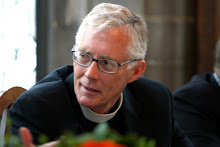
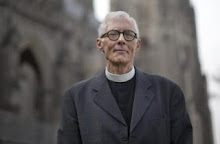
Saturday, September 15, 2012

Homily: The Sixteenth Sunday after Pentecost [September 16, 2012] Christ Church Cranbrook


            There is a Greek proverb: nothing is more permanent than the temporary. I have thought a lot about this saying recently, especially since Kathy and I have spent the last several days sorting, packing, and clearing out the rectory for the move to Washington. Nothing is more permanent than the temporary. We think things are going to stay the way they are forever.  And then, of course, they don’t.
One of the most temporary things of all is the effect one person has on an institution.  It always amazes me that a year or so after I leave a place, I come back to discover that they’re still managing to go on without me.  How can that be?  When you’re deeply immersed in the life of a community, you can’t imagine it continuing without you.  And then, of course, it does.  As Jonathan Sams has said more than once, all life is a preparation for leaving it.  As unthinkable to me as it might be this morning, Christ Church Cranbrook will go on without me when I leave.  Saint Aidan’s, Malibu, All Saints Pasadena, the Church of the Redeemer in Bryn Mawr, Seabury-Western Theological Seminary, all have managed to face each new day without me.  Heck, Washington National Cathedral has managed to go on without me for 105 years.  And of course, you know what’s next:  the world will be able to go on without me when I die.  The older I get, the more I hear that as good news and not bad.  It really isn’t all about me.  It’s about God’s purpose, which goes forward with and without us.  That thought is ever more comforting to me, especially at partings.
Legacies are funny things. I remember, during my first stay here, that Jerry McMechan organized the parish history around the tenures of the then four rectors:  the Marquis years, the Cadigan years, the Dewitt years, the O’Grady years. One of the quirks of my professional life is that I’ve actually known 5 of my six predecessors here. Each one of them faced challenges.  Each one of them had real accomplishments.
            But as I’ve thought about this legacy business, I came upon a blog post by my friend Tom Anderson, whom many here have met through his help with our stewardship process.  Tom is a long time friend, and he has had a significant career as a consultant to educational and nonprofit institutions about leadership, governance, development, and ethics.  In his most recent blog post, he takes on the question of leaders and their legacies.  And here in part is what he says:
Leadership of a nonprofit institution is a relay race; it is not an individual field event.  Leaders accept the baton of leadership from a predecessor and then spend some period of time trying to improve the institution they serve before handing the baton to a successor.  The hope is that a better institution, department, or program is passed on than was received.  And, that is the legacy of leadership … it belongs to the institution and not to the leader. [Tom Anderson, "Legacy . . . What Legacy?" http://andersonandtyner.com/2012/08/legacy-what-legacy/]

That’s the way Tom put it.  The Greeks might put it this way: Nothing is more permanent than the temporary. Love, admire, and respect my six predecessors here at Christ Church as I do, I have finally to admit that what makes this parish great and unique among large suburban churches in the United States has less to do with them than it does with you in the pews. I’m not just saying this to suck up on my last Sunday. Sure, great rectors here have provided great leadership, but a leader is really only important to the extent that he or she can tap into the deep commitments of a community and bring out the talents and energies of its members.  My former bishop and good friend Fred Borsch used to say that a parish rector is really a coach.  Since my only coaching experience was as a Lamaze coach, and that performance got mixed reviews, I had a bit of trouble with Fred’s metaphor.  But you know what he means.  A parish rector is more like a coach or an orchestra conductor, less like a star athlete or soloist.  The skill lies in understanding the missional priorities of the faith community and organizing its ministry around those priorities.  You already had the vision before I came here.  My real achievement, to the extent I had one, was tapping into it.

What is that vision?  When I say that Christ Church Cranbrook is unique among large suburban churches in the United States, what I mean is this:  if you think back on the history of this parish, it has always been a community that cared both about its own neighborhood and about the larger Detroit metropolitan area.  If you read the parish history, you’ll see that from its very inception, Christ Church Cranbrook was involved in the issues that defined Detroit in the 20th century: racism, poverty, regional concerns, open housing.  Many of our clergy and parishioners were involved in the genesis of nonprofit organizations like Crossroads, the Lighthouse, and FocusHope.  Care for the community—and by community I mean the whole area we’ve come to call “Southeastern Michigan”—has always been a hallmark of Christ Church Cranbrook.  You can’t say that about most parishes in affluent zip codes like this one.  Christ Church is most itself when it lives out its mission as a parish where people from this community can give of their resources, skills, and energies not only to alleviate human suffering but also to make real systemic change in the world.  Our current partnerships with FocusHope and with All Saints Pontiac are in the great tradition of this parish’s deepest commitments. Beth Taylor has developed these partnerships in collaboration with parishioners who are passionate about Christ Church’s leadership role in Detroit.

There’s another part to that vision, and it has to do with children.  This has always been a parish dedicated to the nurture of children in the Christian faith and life. Dianthea Higgins, the great Christian educator who served here for so many years, made this place a national laboratory for Christian Education in the 1950s and 1960s.  She was retired by the time I first joined the staff here in 1978, but I knew her also, and she was really something—the kind of leader who could encourage and inspire.  But in the end she, too, was someone who simply read the community aright and called forth the gifts and energies that were latent in it.  Christ Church Cranbrook is most itself when it cares for the wider community.  And Christ Church Cranbrook is most itself when it cares for and advocates for children.  Our current renaissance in children and youth ministry is due both to the talents of Jessica and Beth and to their ability to bring forth what is already at work in you.

I mention outreach and youth because even though they’re essential to this place’s self-understanding, in times of stress they can fall by the wayside.  So I want to make a pitch that these two missional areas remain high priorities in the years ahead.  In holding up outreach and youth, I don’t mean to slight worship and pastoral care, each one a long-time strength of Christ Church. John Repulski is the most talented church musician I have ever known, period.  Joyce Matthews has outstanding and deep pastoral gifts.  Worship and pastoral care are an essential part of the Christ Church fabric, and their longstanding excellence here is obvious to all observers. But worship and pastoral care will always be strong because they are elemental to all churches.  Outreach and youth will always be more of a stretch.

And there’s one more thing—a kind of rectorly, super-secret priority.  And that’s spiritual depth.  I asked Jonathan Sams to come here because of my intuitive sense that it is spiritual depth—real people praying, reading the Bible, sharing their faith stories together—this is what makes a faith community vibrant and healthy.  Jonathan has already organized daily Morning Prayer here in St. Paul’s Chapel Monday through Thursday.  Beth and the clergy are taking on The Bible in One Year on Sunday mornings at 9:00.  I don’t know this scientifically, but I do know it experientially:  the prayer life of a Christian community is what will sustain it both as an institution and as a source of strength and hope in the lives of its people. If I have one piece of advice to this parish, it is this:  read your Bible and say your prayers.  Everything else will flow from that.

By now, you’re thinking to yourself, “This sounds more like Washington’s Farewell Address than it does like a sermon!”  So lest you drive home feeling bereft of homiletical input, consider this:

In today’s Gospel, there are a lot of things happening.  It has become clear to Jesus’s followers that he’s not just a faith-healing teacher:  he’s something more, the Messiah, the Christ, the incarnate Son of God.  Peter is the first disciple to get this.  And once he does, Jesus feels the need to take them step-by-step into the depth of what it means. 

So he says several things.  But here is the one that stands out to me:

‘If any want to become my followers, let them deny themselves and take up their cross and follow me. For those who want to save their life will lose it, and those who lose their life for my sake, and for the sake of the gospel, will save it.’ [Mark 8: 34b-35]


          What we learn over time in the church is this: life is good and beautiful and holy and true to the extent that we come, with Jesus, to live not for ourselves alone but for others. In a world of anxious individualism, we are schooled by our culture to think that it’s all, finally, about me.  But it’s not about me.  It’s about us.  The real answer to everything we fear—loneliness, alienation, want, loss--lies in reaching out and making common cause with others.  Jesus showed that life is abundant when we band together and share it with others. It is not about me.  It is about us.  If you want to save your life, you should lose it in service to and companionship with those who are like you and those who are not.  That is the teaching of Jesus, and it is the legacy of Christ Church Cranbrook.  I will always treasure this parish, its people, and what it stands for.  Nothing is more permanent than the temporary. I don’t have a legacy.  We all do. Let’s celebrate it.  Let’s give thanks for it.  And even though we’ll be separated geographically, we can still live into it, together. Nothing is more permanent than the temporary.
Our time together, like all human sojourns, has been temporary.  Our places in each others’ hearts will always abide. Amen.


Sunday, September 2, 2012

Homily: The Fourteenth Sunday after Pentecost [September 1, 2012] Christ Church Cranbrook

             Everybody loves a sale, and earlier this summer a local men’s clothing store made a seemingly irresistible offer:  buy one, get three free!  This offer applied to everything—suits, jackets, slacks, shirts—the whole works.  So being a canny shopper, I went on the Saturday of the sale in search of new clothes.  For good luck (and as an arbiter of taste) I brought Kathy with me.  Being the son of a woman who worked with movie and television costumes, I have a pretty good sense of what I’m looking for in clothing.  But Kathy over the years has saved me from making some major mistakes.
            We got to the store at around 9:30 a.m.  I picked out and tried on four suits and a like number of slacks and sport coats.  Each of them required tailoring, so I submitted to the tape, chalk, and pin ritual.  I went to the cash register and checked out.  I was a little before 10:00 a.m.  The whole process took just under a half hour.
            Needless to say, Kathy Hall was amazed.  “How could you do that so fast?” The store manager, who had waited on us, took it in stride.  “Men are always like this,” he said.  “They shop much faster than women.”
            Now there are all kinds of possible explanations as to why I bought all these clothes in record time.  Kathy would say it is because of my short attention span.  The words, “You have the patience of a gnat!” have been uttered more than once in our household.  But, without confirming or denying rumors of Adult ADD syndrome, I would suggest another explanation.  It’s not so much that I can’t sit still very long.  It’s more that I’m uncomfortable doing anything very long that focuses attention on my body.
            Somehow, when I get in a clothing store with its full-length mirrors and all those tape measures, I become enormously self-conscious.  I don’t want to look at myself in a full-length mirror.  I don’t want to know what my actual waist measurement is.  When trying on clothes I feel like I’m back in junior high school, trying to come to terms with this awkward physical case I carry my brain around in. 
When I think very long about my body, I fall into the Western Civilization trap of mind/body dualism.  Beginning with the philosopher Plato, we westerners have thought of our minds as somehow separate from our bodies.  We tend to think of our “selves” as our mental functions, divorced from our physical beings. The poet William Butler Yeats (a poet I’ve been reading this summer) said that to be human is to be “fastened to a dying animal” [“Sailing to Byzantium”]. Over time, we have come to think of the mind as our essence, our body as its packaging.  Whenever I go to the clothing store, I turn immediately into a Platonist.
Our Bible readings for today come from a different tradition than Plato, and they offer us an alternative way to understand ourselves.  The Israelites did not think of the human body and the human mind as separate things.  They believed not only that mind and body are one.  They believed that both of them are good.
Take, for example, our first reading today.  It’s from the second chapter of the Song of Solomon, and while you may have heard it read every so often at a wedding, you’ve never heard it read on a Sunday morning in church.
“Arise, my love, my fair one,
and come away;
for now the winter is past,
the rain is over and gone.
The flowers appear on the earth;
the time of singing has come,
and the voice of the turtledove
is heard in our land.
The fig tree puts forth its figs,
and the vines are in blossom;
they give forth fragrance.
Arise, my love, my fair one,
and come away.”
                                                [Song of Solomon 2: 8-13]
What’s going on here?  If this sounds to you like an erotic love poem, that’s because it is.  The Song of Solomon is a short book that describes the attraction of a young woman to a young man, and it talks about human love in expressly physical terms.  The book has had a strange history in Christianity.  It has been studied privately—there are many commentaries written about it over the history of Christian thought—but it has been suppressed publicly.  When Christian writers have thought about it at all, they have understood it as an allegory of the soul’s relation to God:  they cast the woman in the poem as the soul, the man as God.  They have read it in a spiritualized, Platonic way.  Jews, of course, have read the poem much more literally than we have.  They haven’t been infected with mind/body dualism the way we Christians are.  It’s only with the adoption of the new Revised Common Lectionary in the last few years that adult Christians have been considered grown up enough to be exposed to this explosive piece of biblical love poetry.
            The first point I want to make this morning, then, is that finding the Song of Solomon in our Bibles should alert us that God wants us to understand ourselves rather differently than we have.  You and I are products of a Western culture that still thinks of our minds as good and our bodies as bad.  The Bible knows nothing of this division.  It not only accepts our bodies.  It celebrates them.  God created men and women in God’s own image.  God took on human flesh in Jesus.  The physical love of the two people in the Song of Solomon is an image of the function of divine and human love at work in the world.  As Freud knew, the love the Greeks called eros binds us to other people and the world.  Love is not some gaseous, spiritual idea.  It is fleshly and embodied.  And it is good.
            But even though the Jews were not vulnerable to mind/body dualism, they, as we do, often fell into the trap into thinking that real religion was somehow all about being “pure”.  When Jesus criticized the Temple cult of his day, he was primarily attacking the purity codes that had built up over time as a false way of understanding the holy.  It’s not so much that Jesus disagreed with the Jewish idea of clean and unclean.  What he objected to was the way in which that distinction got applied to every aspect of life, including the classification of human beings. 
In today’s Gospel, the Pharisees criticize Jesus’s disciples for eating with “defiled hands”.  Remember that this interchange takes place long before our modern understanding of antisepsis and infection.  The Pharisees call those hands “defiled” not because they carry viruses and bacteria.  They call them “defiled” because they are ritually unclean.  They may have touched the wrong kind of food or the wrong kind of person.  But, like many religious rules they have expanded out of all proportion.  That’s why Jesus says to them,
"Isaiah prophesied rightly about you hypocrites, as it is written,
'This people honors me with their lips,
but their hearts are far from me;
in vain do they worship me,
teaching human precepts as doctrines.'
You abandon the commandment of God and hold to human tradition."  [Mark 7: 6-8]
And he goes on to tell them that real defilement, real uncleanness, has more to do with personal intention than it does with physical substances.  In thinking of certain things as dirty and other things as clean, the Pharisees had fallen into the mind/body trap.  By living as one at home in his body and the world, Jesus was calling them back to the tradition of robust physicality expressed in the Song of Solomon.  God made us and the world and called them good.  Heaven is not some spiritual zone in the sky someplace.  Heaven is earth perfected, it is earth made new.  As we say in the Nicene Creed, we believe in the resurrection of the body.  I don’t know how that works, but I do know that Christian faith proclaims that in life and in death the mind and the body are one.
And there’s one more thing to be said.  This is Labor Day weekend, a holiday that has come to be more about the end of summer than about a celebration of human work.  But if we take all that has gone before seriously—if we agree that God made us in the divine image, that God made the world and called it good, that our bodies are as holy as our minds, that redemption is about building a new heaven and a new earth—if we take all that as given, then we cannot help but see that there is something good and holy and necessary about human work.  God made the world and is always making it new.  God is calling us—in Jesus, in baptism, in our own personal vocations—to help in that work of creating and blessing and redeeming the world as well.
The older I get, the fewer things I believe.  But the things I do believe have become the core affirmations of my spiritual, vocational, and personal life.  And one of the things I do believe very deeply is that human work—professional work, volunteer work, work done inside the home or out in the world—all human work matters.  God made us fleshly embodied beings in a real world.  God gave us love to bind us to each other and the world.  God has given us gifts and skills and has called us to tasks that empower us to participate with God in making that new heaven and new earth God promises.
So on this Labor Day, let’s not be like Plato and the Pharisees.  Let’s not confuse the relation of our spirits and our bodies.  Let’s be like the man and the woman in the Song of Solomon, like Jesus with his disciples.  Let’s accept ourselves for who we are and our world for what it is.  Let us allow our love to bind us to each other and the world.  And let us be about the work of making this real, embodied world a new and more perfect place. No matter how you feel about your body, God loves it and so should you.  No matter how you feel about your work, God values it and so should you. No matter how you feel about your relationships, God uses them as a primary way to know and love you.  On this Labor Day weekend, let’s join in our church’s prayer for this holiday:
Almighty God, you have so linked our lives one with another that all we do affects, for good or ill, all other lives: So guide us in the work we do, that we may do it not for self alone, but for the common good; and, as we seek a proper return for our own labor, make us mindful of the rightful aspirations of other workers, and arouse our concern for those who are out of work; through Jesus Christ our Lord, who lives and reigns with you and the Holy Spirit, one God, for ever and ever. Amen. [For Labor Day]


Sunday, August 19, 2012

Homily: The Twelfth Sunday after Pentecost [August 19, 2012] Christ Church Cranbrook


            What does it mean to be “wise”?
I have a priest friend who regularly sends emails that always address me as “O Wise One”.  You can hear in that greeting just the tiniest bite of irony.  Yet I think of him and his slight smirk whenever I hear the story of Solomon asking for an understanding mind. Hearing this story, I cannot help but think that Solomon manipulated God pretty well.  Because Solomon asked for wisdom and not for long life or riches, God gave him all three.  Solomon was not only wise but canny. He played the big guy. With good reason, the phrase, “the wisdom of Solomon”, is proverbial to this day.
            Anyone who has read Mark Twain’s Adventures of Huckleberry Finn will never forget the colloquy between Huck and the runaway slave Jim about this proverbial Solomonic wisdom.  As they travel down the Mississippi on a raft, Huck and Jim get into an argument about the claim that Solomon was the wisest man who ever lived. Huck affirms it, but Jim is not so sure.  He remembers the story of the two women who came to Solomon both claiming to be the mother of the same baby.  Solomon solved the dilemma by ordering that the child be cut in half.  The true mother, of course, objected to the plan, thereby proving her authenticity and gaining custody of the child.  Perhaps she played Solomon the same way Solomon played God.
            Nevertheless, Jim will have none of it.  He says,
I don’t care what the widow says, he wasn’t no wise man neither.  He had some of the dad-fetchetest ways I’ve ever seen. Do you know about the child he was going to chop in two? . . . What use is half a child?  I wouldn’t give a darn for a million of ‘em.” [Mark Twain, Adventures of Huckleberry Finn, Chapter 14]
            Huck is scandalized by Jim’s seeming inability to understand Solomon’s judgment. "But hang it, Jim, you've clean missed the point—blame it, you've missed it a thousand mile." But has Jim missed the point?  To Jim, a runaway slave separated from his family, children are precious.  Threatening to cut a child in two is about the stupidest thing he can imagine. If he could imagine such a thing, Solomon couldn’t have been all that wise.
            We tend to think of “wisdom” as a depth of character that comes from a long or virtuous life.  Jim seems to understand wisdom as an empathic ability to feel the joys and pains of others.  The Bible seems to use the word “wisdom” in an entirely different sense. What’s with all these different meanings?
            Let’s start with the conversation between Solomon and God.  Over the past several weeks we have been reading the story of King David’s rule—his ascension to power, his sin regarding Uriah and Bathsheba, the revolt of his son Absolom against him.  In today’s Old Testament reading, David has died and his son Solomon ascends the throne.  Solomon shows himself to be a pretty canny politician by travelling around the country, offering sacrifice at all the local sanctuaries, a kind of Bronze Age campaign road trip.  When God asks Solomon what he wants, Solomon is already smart enough to know not to ask for a long life or riches but for wisdom.  God responds by praising the request and granting him all three.
            The term used both by Solomon and God in this dialogue is chokmah, the Hebrew word for wisdom.  There are two words used in the Bible that we translate into English as “wisdom”: one Hebrew, the other Greek. The Greek word is sophia—the root of our word “philosopher”-- and it comes to us from the world of Western philosophy. But the wisdom that Solomon and God are talking about is Near-Eastern pragmatic, not Western, philosophical wisdom.  It is not sophia.  It is Jewish wisdom, chokmah, and Jewish wisdom is a much more practical affair.  Here is how one Old Testament scholar describes it:
The Hebrew word for wisdom (chokmah) carries no theoretical or abstract connotations; nor is it the equivalent of “thought” or “philosophy”. . . Chokmah is used often to denote technical skill, and in other contexts “experience or shrewdness” in practical and political affairs.  [Harvey H. Guthrie, Jr., Israel’s Sacred Songs, p. 171]
            Remember that Solomon has just become a king, and the first thing he’s done in his new role is make strategically important appearances at the holy places in his new realm. He doesn’t particularly want philosophical, reflective wisdom.  What he wants is the skills to do his job, to run his country.  So when Solomon asks for wisdom, and when God grants it to him, what they’re talking about is chokmah, practical shrewdness in managing human affairs.  He wants to be able to navigate the rapids of human relationships, politics, and motivations.  He wants to be able to hold his own in his dealings with other people.
            In this as in so many other ways, the Bible and the faith made real in it are essentially pragmatic.  The Bible is a book about God being known in the stuff of human life and relationships.  It is not idealistic or particularly pious about how human beings behave.  Again and again, God’s work gets done through the complex human matrix of double dealing, bad faith, and aggression.  The miraculous aspect of biblical faith, if there is one, consists in God’s consistent ability to bring love out of hate, goodness out of evil, life out of death.  Today, when people describe themselves as “spiritual but not religious”, I know what they’re saying but I think they’ve got it exactly backwards.  The Bible—and biblical faith—is religious but not particularly spiritual. It understands that there is a decorum to the relationship of people with God, but it is not at all Romantic about it. Solomon and God read each other like a couple of old men playing gin rummy. Each knows what the other is up to.  But they find a way to go forward together because they’re not at all deluded about what’s really going on.
            This morning we said, in Psalm 111, one of the most familiar sayings in scripture:
The fear of the LORD is the beginning of wisdom [chokmah]; *
     those who act accordingly have a good understanding. [Psalm 111:10] 
 
From the Bible’s point of view, from Christianity’s point of view, real wisdom begins in an orientation toward God.  Because wisdom is finally about relationship, it appropriately starts with a stance toward God.  You cannot be wise relative to your fellow human beings if you are not first wise toward God.  And you cannot get wise with God casually.  Just as a human relationship takes care and nurture, so a relationship with God needs continual attention.  That’s why people like me talk so much from pulpits like this urging coming to church.  Sure, I want you here so that our numbers look good.  But more than that, I want you here because this is a focused way for God to get your attention.  I don’t doubt that you can meet God on the golf course. But I know that, on the golf course, you’re thinking more about your swing than about the Deity. And while that may be prayerful thinking—God help me not to slice or hook here!—in the moment the ball’s flight and not God are at the center of your attention.  If you want a relationship with God you’ve got to plan to spend some time together.  And the long experience of Christians, Jews, and Muslims is that regular corporate and individual prayer is the only reliable way to do that.
I think that the connection between wisdom and developing a relationship with God is what Jesus is talking about in the Gospel this morning:
"I am the living bread that came down from heaven. Whoever eats of this bread will live forever; and the bread that I will give for the life of the world is my flesh." [John 6:51]

This “bread of life” discourse takes up several weeks of our Gospel readings this summer, and because it’s a complex passage there are many smart, ingenious, sophisticated things to be said about it.  But in the terms we’ve been thinking in this morning, Jesus’s talk about the bread of life says something profound to each of us about where real wisdom—real chokmah, real skill in navigating the rapids of life—can be found. 
Jesus is the bread of life.  That is true both literally and figuratively.  Jesus is the bread of life literally because the Eucharist, the bread and wine of thanksgiving, is the ongoing sustenance we need for the work of relating to each other and the world.  If you want to get to know someone, have a meal with them.  When we gather together to share the bread and wine of communion, we are dining not only with each other but with Jesus and God.  Over the course of a lifetime, we become familiar with each other.  Jesus is the bread of life literally because as we eat this bread we become more sensitive and attuned to what God is up to.  We can read God just as Solomon could when he asked for wisdom.
And Jesus is the bread of life figuratively.  Think about how he lived.  He gathered people uncritically and generously around his table.  He healed and taught, blessed and forgave.  Living as Jesus lived—simply and courageously, with grace and compassion—this is real living as God intended it.  Living as Jesus lived is finally what human life and human wisdom are all about.  If you want to be wise in the Bible’s sense of that word, you don’t need to read more books or live to be 150.  All you need to do is to come to church, say your prayers, and keep your eyes on Jesus.  He is the bread of life, and the nourishment of this bread is real wisdom.  And as Solomon knew, once you have that you really have everything else, as well.  Amen.

Sunday, August 5, 2012

Homily: The Tenth Sunday after Pentecost [August 5, 2012] Christ Church Cranbrook

            This morning’s Old Testament reading—the story of King David and the prophet Nathan--makes me think of James Joyce’s great short story, “The Dead”. Without retelling the plot in detail, “The Dead” shows us a man named Gabriel Conroy who, over the course of the story, is allowed to see into himself.  Late in the evening after a party, Gabriel learns something new about his wife, Gretta:  when she was a young woman, a bedridden boy, Michael Furey, loved her so deeply that he got up from his sickbed and walked miles to her house and stood in the rain outside her window the night before she was being sent away to school.  He died within the wee
Gabriel has lived his whole married life with Gretta not knowing that story. At the very end of “The Dead” Gabriel realizes that he has never really known his wife or himself.  He has lived his life emotionally disconnected from other people and his own feelings. When he hears this story of young love, he is opened to a new vision of his wife, himself, and the ultimate connection of all people.  As Joyce describes it,
Generous tears filled Gabriel's eyes. He had never felt like that himself towards any woman, but he knew that such a feeling must be love. The tears gathered more thickly in his eyes and in the partial darkness he imagined he saw the form of a young man standing under a dripping tree. Other forms were near. His soul had approached that region where dwell the vast hosts of the dead. He was conscious of, but could not apprehend, their wayward and flickering existence. His own identity was fading out into a grey impalpable world: the solid world itself, which these dead had one time reared and lived in, was dissolving and dwindling.
In this one moment, Gabriel sees both his own selfishness and his ultimate connection to other people.  The power of this sudden realization (Joyce called it an “epiphany”) is similar to what we see in the story of David the king and Nathan the prophet in this morning’s Old Testament reading.  If you were in church last week, you heard the first part of the story.  David is so attracted to the woman Bathsheba that he sends her husband to certain death in battle, his aim being to claim and marry Bathsheba when she is widowed. David’s plan succeeds, and Bathsheba becomes his wife.
In today’s reading, the prophet Nathan comes to David and tells him an allegorical version of his own story.  Instead of using one of his many lambs to feed a traveler he wants to entertain, a rich man takes the one, precious lamb belonging to a poor man.  David hears this tale and is enraged. He says, “The man who has done this deserves to die!”  Nathan says, “You are the man!”
In an instant David realizes the extent of his own wickedness and sin. "I have sinned against the LORD." In the coming weeks, we will hear of the turmoil that descends on David’s family as a result of this selfish act.  But for the moment, let’s stay with depth of David’s sudden view into himself.  Like Gabriel Conroy in Joyce’s story, David has a flash of insight.  He sees himself as he is.  He doesn’t particularly like what he sees.  But there is grace in this revelation.  He can take it in, and because he can take it in he is able to grow and change.
The story of David the King and Nathan the prophet has much to say to us this morning.  I would like to talk with you about it in two of its aspects:  as a personal story of self-understanding, and as a parable of the relation between the faith community and our public life.
As many of you know, the big news this week for the Halls is that Kathy and I will be leaving here next month to move to Washington where I’ve been called as the Dean of Washington National Cathedral.  This has been a surprising piece of news to many, especially as we’ve been here not quite three years.  The responses have been all over the place:  congratulatory, sad, angry, even cynical.  I certainly understand the range of those feelings.  When we came here in late 2009 we were sure that this would be my last job and we’d be here for a good while. 
I have to tell you that I did not go after the position at the Cathedral.  When they asked if I’d be a candidate, my first thought was, “I’m very happy where I am.  I don’t need to do this.”  But as I engaged the search process, it became clear to me that this was something I needed to do.  When I compared the Cathedral’s needs and my gifts, I realized that I have a particular set of skills and experience that the Cathedral needs at this moment in its history.  And because Washington National Cathedral is the public face of the Episcopal Church in America, its recovery from last year’s earthquake and its flourishing as the nation’s church is important work on behalf of the whole church.
The point here is, that like David and like Gabriel I have gone through a time when I have had to look inside, where God has shown me some aspects of myself.  I’ve had to wrestle with the tension between humility and ambition. We all have moments like that. The first idea this morning relates to David’s aha! moment.  “You are the man!” "I have sinned against the LORD."  A big part of what God does in our lives over time is help us mature in the faith to the point where we can accept and acknowledge ourselves as we are.  The monk and writer Thomas Merton defined salvation as claiming our unique identity, living as one’s authentic self.  The longer I’m around, the more I agree with him.

One way to understand sin is to see it as a kind of selfishness.  Another way to understand it is as a form of self-hatred.  We tend to think we are good or loveable or holy only insofar as we line ourselves up against an idealized set of criteria.  As Merton shows us, one deep Gospel truth is that all people, all things, are good in and of themselves.  We get into trouble when we distrust that, when we think we have to be someone or something other than who and what we truly are.  God became human in a real, specific person, Jesus of Nazareth.  By so doing, God blessed each of us in our uniqueness and showed us that living faithful to the logic of our lives as Jesus did is the only thing that ultimately matters about being human.
There’s a second idea in this David-Nathan story, too, and it relates to the work I am going next to do.  Israel was always suspicious of kings.  So as the role of king arose so did the role of prophet.  For every king in Israel there was also a prophet, a person called and appointed to remind the king, both personally and socially, of God’s values.
Now I’m not so bold as to think of myself as Nathan to Obama’s or Romney’s David.  But I do believe that we are at a point in America where the faith community must assert its role as the prophetic community reminding our divided and dysfunctional leaders of God’s values as they relate to our public life.  This is not to be confused with a personal “speaking truth to power”, a phrase I have always disliked.  (As Noam Chomsky says, power already knows the truth and they certainly don’t want to hear it from you.)  It’s not speaking to anybody.  It’s speaking with them.  I believe that the faith community—Christians, Jews, Muslims, Buddhists, Hindus—I believe the faith community can reassert its relevance in the 21st century by convening a conversation among the polarized and divided constituencies of our national life.  The aim of this conversation is to find common ground for shared work that will advance the common good. Common ground for the common good united in common prayer is a very Anglican way to see the relation of faith and politics.
We are all part of something bigger than ourselves.  From the Puritans to the Civil Rights movement, from the Great Awakening to the Moral Majority, Progressive and Conservative Americans have always seen a religious dimension to our national life.  We in the religious community have retreated of late from our historical role not only as the nation’s conscience but as the people who can stand with those on both sides of the divide and pull them together in the service of a more just, compassionate, and free society.  Nathan’s ministry to David in today’s Old Testament passage reminds us that you and I, as members of this church and as people of faith, are called to be the voice of God’s values in a broken world.
This morning, I ask that you think of yourself as someone God loves enough to tell the truth to, and that you can come from that revelation into empowered to bring your faith into the world.  God loves you in the places you don’t even know about and accept.  God loves other people that way, too. God calls all of us to be agents of love, justice, healing and hope in the world.  God calls all of us to see that the truest thing about all of us is our connection to each other and to God, the source and ground of our being.
It’s all finally about self-acceptance and connection.  That’s what Jesus modeled for us.  That’s how we can live. Here is how James Joyce describes what goes through Gabriel Conroy’s mind at the end of his story, “The Dead”:
Snow was general all over Ireland. It was falling on every part of the dark central plain, on the treeless hills . . . It was falling, too, upon every part of the lonely churchyard on the hill where Michael Furey lay buried. It lay thickly drifted on the crooked crosses and headstones, on the spears of the little gate, on the barren thorns. His soul swooned slowly as he heard the snow falling faintly through the universe and faintly falling, like the descent of their last end, upon all the living and the dead. [James Joyce, “The Dead”, Dubliners]
Amen.