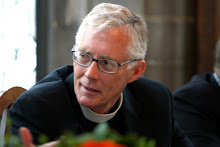
Although I am a longtime admirer of John Muir (hey, the guy’s on the back of the California quarter!), I must admit that until a couple of days ago I had never heard of Hudson Stuck. John Muir, as many of us know, was a naturalist and writer who emigrated from Scotland to Wisconsin and then spent most of his life in California. He is most famous as the author of The Mountains of California, My First Summer in the Sierra, and as the founder of the Sierra Club. Hudson Stuck was also an immigrant: born in England he came to America in 1885 and attended the University of the South. He was ordained a priest and served as Dean of the Cathedral in Dallas, Texas before becoming Archdeacon of the Yukon in 1905. He was well-known in his day as the author of such books as Ascent of Denali and Ten Thousand Miles with a Dog Sled. In 1913 he organized the first successful ascent of Mount Denali.
Now I never quite know what our lectionary makers are up to when they set aside days for us to remember saints. I don’t know if Muir and Stuck were friends, but aside from their love of nature I’m not sure they had a lot in common. While Hudson Stuck was both a mountaineer and a priest, John Muir was not what any of us would call conventionally pious. I always get nervous when our church tries to claim celebrities as our own—I’m old enough to remember how we bragged when Vice President Spiro Agnew was an Episcopalian, a fact we tried to hide after Watergate—and I’m not sure that Muir would appreciate being lumped together with the Archdeacon simply because they are dead Britons who loved the American west. But taken on their own terms, each is an admirable person and their separate and joint witness has something important to tell us about our own relationship to God in nature.
What has always interested me about John Muir’s life is the moment when he made the vocational transition from nature-lover to activist. When you read Muir’s earlier writings, you get the sense that his earliest experiences of nature were private, personal ones. He moved to Yosemite Valley and lived there because he loved the transcendent qualities he experienced there. But, over time, Muir began to realize that some kind of collective action had to be organized to save the California wilderness from the encroachments of industrial society. So Muir gave up living in the wild and moved back into the world and in 1892 organized the Sierra Club. In 1901 he led the unsuccessful fight to stop San Francisco from buying and flooding the Hetch Hetchy valley, a near duplicate of Yosemite, also in the Sierra. For the rest of his life, John Muir was a tireless advocate of natural preservation.
And something like this transition from nature-lover to advocate took place in the life and ministry of Hudson Stuck. Though Stuck obviously combined the active and contemplative lives by being a mountain-climbing Archdeacon, he too moved more and more into political activism on behalf of the natural world as he got older. Stuck’s last great cause became his effort to outlaw large fishing ships called “floating canneries”, and this campaign led to the regulations of 1920 for salmon conservation in Alaska and the restoration of native fishing rights. As they aged, both men moved from a spirituality of individual “communing with nature” to a corporate, communal understanding of nature as a shared and sacred space to which all creatures, including people, have rights of access.
The Gospel which we’ve read today [Luke 8.22-25] tells the familiar story of Jesus calming the storm: “They went to him and woke him up, shouting, ‘Master, Master, we are perishing!’ And he woke up and rebuked the wind and the raging waves; they ceased, and there was a calm.” [Luke 8.24] Just as I’m a bit suspicious of the lectionary-makers, so I’m not so sure that Luke would understand being in touch with nature in the same way you and I would. If anything, this story seems to be about command and control rather than about organic connectedness. Nevertheless, beneath the easy and overt connection that’s being proposed, I think there is a deeper and truer way in which this story about Jesus says something about John Muir, Hudson Stuck, the planet, and us.
What has always struck me about this story in Luke’s Gospel is the way it shows us a Jesus who knows who he is. And what Jesus knows in this particular moment is that he is at home in God’s world. Right now, that world appears to be a dangerous place: the winds are roaring and the waves are crashing. But Jesus knows he is safe there because he knows that this world is God’s world and his world, and so it is his home. He belongs to it. He knows it, he loves it, he accepts it on its own terms. And so he is able to speak to it precisely NOT from a command-and-control mode but from a posture of love.
And it is by speaking to the world from that sense of being at home and that posture of love that Jesus is able to take on advocacy on behalf of those in the boat with him, people who operate out of alienation and fear, who see the natural world as more of a problem than a gift. So in a profound way, Jesus embodies the characteristics we admire in John Muir and Hudson Stuck. He loves the natural world on its own terms and makes himself at home there. And his love for that world moves him beyond mere appreciation of it into advocacy both for it and for the people with whom he is in community. Jesus knows what America’s indigenous people know: that the natural world is as much about community and justice as it is about Romantic transcendence.
Today, of course, is Earth Day, an occasion celebrated in America since 1970. As we gather at Jesus’s table to give thanks on this day for the created world and our place in it, let us remember and give thanks for the lives and witnesses of John Muir and Hudson Stuck. Yes, they were sensitive souls who responded to the sublime transcendence of the natural world. But they answered God’s call in their lives to be more than chroniclers of nature and its beauties. They stepped into the responsibility of standing for and with God’s world against those who would treat it as an object and not as the precious subject that it is. Like Jesus, Muir and Stuck loved the world, were at home in it, and they gave the last part of their lives in service not only to the planet but to all us creatures who live on it together. It is not enough just to admire something or someone. True love and compassion call us toward the next step—to move beyond appreciation into advocacy. May we embrace this day’s calling with similar love and commitment. And may we also gather at Jesus’s table in solidarity with John Muir, Hudson Stuck, and all those who love and serve God’s world and God’s people, and together with them give thanks. Amen.
Wednesday, April 22, 2009

Thursday, April 9, 2009
Homily: April 9, 2008 [Maundy Thursday]
A few weeks ago I saw a presentation in a parish I was visiting in which a priest was talking about the Lord’s Prayer with teenagers. As much as I like and admire this priest, I couldn’t help finding his discussion of prayer and its obligations rather one-sided. In this account, we’re supposed to hallow God’s name and declare God’s glory because we’re all God’s creatures and that’s what God’s creatures are supposed to do. That’s all true enough, I said to myself as I listened, but why exactly is this equation he describes so one-sided? What is God’s obligation toward us? The God whom this man described was at best a benevolent despot, a being mysteriously insistent on being hallowed and glorified. There was no suggestion in anything he said to these kids that there might be some deeper mutuality to this relationship. The Lord’s Prayer sounded as he spoke like a decidedly uneven proposition.
I want to go easy on my clerical friend, because this assumption about the one-way obligations of the divine-human relationship is broadly shared in our church culture. About a decade or so ago I attended a clergy conference led by Martin Smith, a priest and monk and writer, who told a story about a question he often poses to clergy coming to the monastery on retreat. On the first night he tells them to go back to their room and ask themselves what they would like Jesus to do for them. Without fail, he said, the next day the clergy always show up with long lists of what they are supposed to do for Jesus. No, Smith said, you didn’t hear me right. I didn’t want you to ask what Jesus wants you to do for him; I asked you to think about what you want Jesus to do for you. Not surprisingly, when the question is put that way, his retreatants have a very hard time coming up with any ideas. Jesus do something for me? Isn’t that backwards?
That’s the way it is in this Gospel for Maundy Thursday. When Jesus washes the disciples’ feet, Peter becomes distraught.
"Lord, are you going to wash my feet?" Jesus answered, "You do not know now what I am doing, but later you will understand." Peter said to him, "You will never wash my feet." [John 13]
Though we are tempted to think of Peter as they guy who never quite gets it, in tonight’s Gospel it looks to me as if he responds as any one of us might. Jesus is the teacher, the disciples are his students. The normal order of things in a hierarchical culture is for them to serve him. Jesus calmly but radically turns that hierarchy upside down. He establishes the primary obligation as being on his part, not theirs. He serves them.
I’m not a big fan of long homilies in Holy Week, so tonight let’s just sit with Martin Smith’s question as we think about the events we witness tonight, tomorrow, and Sunday. At most parish churches last Sunday many of us shouted “Crucify him!” as part of that dramatized Palm Sunday reading of the Passion Gospel. If you’re anything like me, you’ve thought a lot this Lent about the many and myriad ways in which you regularly let God and Jesus down. Fair enough.
But it’s too simple to say that we are the crowd in that Gospel. It’s more true to say that we are both the crowd and Jesus. And tonight Jesus’s act of washing his companions’ feet asks us to think about why God and Jesus are going through this whole experience of betrayal, crucifixion, and death in the first place. They are going through it for you and me. They are going through it because you and I are worth something to them. They are going through it because we’re precious enough in Jesus’s sight for it to be worth his while to wash our feet.
Maundy Thursday is both a penitential and joyous occasion: we gather both to lament Judas’s betrayal of Jesus and to give thanks for Jesus gift to us of the Eucharist as the way to be together in the world. As you enter into these three days of betrayal and death and resurrection, what is it that you want God to do for you? What is your need for God right now at this moment in your life? What would grace for you look like? How do you want God to act toward and for you? How have you been betrayed or misunderstood or mocked? How would God heal and restore you in the light of that? What would new, risen life look like for you if you dared to ask for it?
"Unless I wash you, you have no share with me," Jesus replied to Peter. In one sense we should hear that as judgment. But, in the context of the infinite love which undergirds the mighty acts of these three great days, we should hear that as a promise, too. Jesus washed his companions’ feet; God hears our prayers not because we grovel but because we are loved. Use the time between Maundy Thursday and Easter to ask yourself and God what you need Jesus to do for you. And then do your best to live-- creatively and joyously and maybe even with a little bit of risk and a lot of love-- into the answer you hear. Amen.
I want to go easy on my clerical friend, because this assumption about the one-way obligations of the divine-human relationship is broadly shared in our church culture. About a decade or so ago I attended a clergy conference led by Martin Smith, a priest and monk and writer, who told a story about a question he often poses to clergy coming to the monastery on retreat. On the first night he tells them to go back to their room and ask themselves what they would like Jesus to do for them. Without fail, he said, the next day the clergy always show up with long lists of what they are supposed to do for Jesus. No, Smith said, you didn’t hear me right. I didn’t want you to ask what Jesus wants you to do for him; I asked you to think about what you want Jesus to do for you. Not surprisingly, when the question is put that way, his retreatants have a very hard time coming up with any ideas. Jesus do something for me? Isn’t that backwards?
That’s the way it is in this Gospel for Maundy Thursday. When Jesus washes the disciples’ feet, Peter becomes distraught.
"Lord, are you going to wash my feet?" Jesus answered, "You do not know now what I am doing, but later you will understand." Peter said to him, "You will never wash my feet." [John 13]
Though we are tempted to think of Peter as they guy who never quite gets it, in tonight’s Gospel it looks to me as if he responds as any one of us might. Jesus is the teacher, the disciples are his students. The normal order of things in a hierarchical culture is for them to serve him. Jesus calmly but radically turns that hierarchy upside down. He establishes the primary obligation as being on his part, not theirs. He serves them.
I’m not a big fan of long homilies in Holy Week, so tonight let’s just sit with Martin Smith’s question as we think about the events we witness tonight, tomorrow, and Sunday. At most parish churches last Sunday many of us shouted “Crucify him!” as part of that dramatized Palm Sunday reading of the Passion Gospel. If you’re anything like me, you’ve thought a lot this Lent about the many and myriad ways in which you regularly let God and Jesus down. Fair enough.
But it’s too simple to say that we are the crowd in that Gospel. It’s more true to say that we are both the crowd and Jesus. And tonight Jesus’s act of washing his companions’ feet asks us to think about why God and Jesus are going through this whole experience of betrayal, crucifixion, and death in the first place. They are going through it for you and me. They are going through it because you and I are worth something to them. They are going through it because we’re precious enough in Jesus’s sight for it to be worth his while to wash our feet.
Maundy Thursday is both a penitential and joyous occasion: we gather both to lament Judas’s betrayal of Jesus and to give thanks for Jesus gift to us of the Eucharist as the way to be together in the world. As you enter into these three days of betrayal and death and resurrection, what is it that you want God to do for you? What is your need for God right now at this moment in your life? What would grace for you look like? How do you want God to act toward and for you? How have you been betrayed or misunderstood or mocked? How would God heal and restore you in the light of that? What would new, risen life look like for you if you dared to ask for it?
"Unless I wash you, you have no share with me," Jesus replied to Peter. In one sense we should hear that as judgment. But, in the context of the infinite love which undergirds the mighty acts of these three great days, we should hear that as a promise, too. Jesus washed his companions’ feet; God hears our prayers not because we grovel but because we are loved. Use the time between Maundy Thursday and Easter to ask yourself and God what you need Jesus to do for you. And then do your best to live-- creatively and joyously and maybe even with a little bit of risk and a lot of love-- into the answer you hear. Amen.
Monday, March 30, 2009
Homily: Monday in the Fifth Week of Lent
The older I get, the more I understand salvation in the terms which Thomas Merton used to describe it. “For me,” Merton said, “to be a saint means to be myself. Therefore the problem of sanctity and salvation is in fact the problem of finding out who I am and of discovering my true self.” [New Seeds of Contemplation, p. 31] The most pernicious effect of our culture is the way it thrives by alienating us from ourselves. Its materialism implies that we can only be ourselves by consuming things produced by others. Its ceaseless internet and broadcast noise distracts us from our interior lives. We don’t know who we are, let alone what we feel, what we think.
These problems are not new, of course. Take, for example, the problem of desire. The story of Susannah and the elders has long been used as a figure for what happens when the respectable folk repress their desires. One of Wallace Stevens’s great early poems, “Peter Quince at the Clavier”, talks in just such language:
Thinking of your blue-shadowed silk,
Is music. It is like the strain
Waked in the elders by Susanna:
Of a green evening, clear and warm,
She bathed in her still garden, while
The red-eyed elders, watching, felt
The basses of their beings throb
In witching chords, and their thin blood
Pulse pizzicati of Hosanna.
Because he is an artist, Stevens’s Peter Quince is present to what he is feeling. The “red-eyed elders” are not: the Bible story uses the almost comic secrecy and confusion as a way of showing the elders’ alienation from themselves: “Both were overwhelmed with passion for her, but they did not tell each other of their distress, for they were ashamed to disclose their lustful desire to seduce her.” [Susannah 1.10-11] The ugliness and violence to which the elders resort shows that there is nothing more dangerous in this world than a self-unaware person capable of wielding power. The elders’ desire for Susannah expresses itself not as love but as aggression. Because they do not know and accept their own feelings they translate their shame into threats toward the person who symbolizes what they desire. It’s as if they want to kill the person who arouses them.
This form of blaming the victim is not new. We see it all through the racial and sexual stereotypes of human history. We see it in church sexual misconduct. And we see it most potently today in the eighth chapter of John’s Gospel, the account of Jesus, the Pharisees, and the woman taken in adultery. Like the elders in the Susannah story, the Pharisees in this account are using their very respectability as a shield against their own interior lives. I wonder how Jesus would have responded if they had simply come up to him and said, “Jesus, help us. We want to sleep with women who are not our wives.” But of course they don’t do that. Instead, they bring in the adulterous woman. [Note: they do not bring the adulterous man! If they caught her in the act, there needed to be what we used to call a “co-conspirator”. Where is he in all this? I wouldn’t be surprised if he were one of the woman’s accusers.] They ask Jesus whether she should be stoned, in accord with Mosaic law. And he replies with this famous and inscrutable gesture: John tells us, “Jesus bent down and wrote with his finger on the ground.” [John 8.6] When finally pressed for an answer, Jesus responds with one of his most famous teachings: “‘Let anyone among you who is without sin be the first to throw a stone at her.” [John 8.7] Instead of blaming the one who elicits desire, Jesus dares to expose the interior lives of the Pharasaic accusers to light. Instead of focusing on “the other”, Jesus says, pay attention to what is going on within yourself. Instead of worrying about what all those other people are doing in their bedrooms, pay attention to what you are doing in yours. Instead of projecting all the things in yourself that you can’t accept onto women, people of color, gays and lesbians, and undocumented workers, come to terms with the parts of yourself that you do not acknowledge, let alone understand.
All of us do this, of course. The point here today, in this fifth week of Lent, is that Jesus points us to self-knowledge and self-acceptance as the keys to personal and spiritual wholeness. When I refrain from picking up the stone to throw at you, I do that in Jesus’s terms because I’ve come to see that the behavior for which I want to stone you is actually an expression of the aspects of my own identity that I want to refuse. And so in putting down the stone I’ve not only taken a step toward self-awareness, I’ve also taken a step into community. Because if we are one in our sinfulness we have the beginnings of solidarity with each other. Our oneness in sin is, as Bill Coffin used to say, “no mean bond.”
And then there is that mysterious gesture. “Jesus bent down and wrote with his finger on the ground.” He did it not once but twice. Every reader of this story has a different take on what Jesus was writing there, but I don’t think he was making a list of the Pharisees’ sins. I think, instead, he was looking into himself. Something about his encounters with women—here the woman taken in adultery, in Mark’s Gospel they Syro-Phonecian woman, not to mention Mary and Martha, Mary Magdalene, and a host of others—something about these encounters calls forth something in Jesus we have not seen before. I think that when Jesus wrote in the earth he was taking account of his own internal life, he was exploring and describing all of the complex feelings and thoughts that this woman and her predicament elicited. As she is “taken in adultery”, so Jesus is caught in the act of knowing, discovering himself. This gesture of looking inward and writing is something that the woman’s accusers and Susannah’s elders are incapable of. Their responses project outward and so result in aggression. Jesus’s response turns inward and so results in compassion. “Neither do I condemn you. Go your way, and from now on do not sin again.” [John 8.11]
As we head into Holy Week, let’s remember that it was precisely the kind of self-awareness which Jesus exemplified which drove his self-unaware opponents crazy and eventually sent him to the cross. The big Holy Week drama we are about to encounter essentially re-enacts the age-old conflict between those who know and accept themselves and so can come to accept others and those who don’t. The real power of the resurrection is the way in which it shows that God can love and bless everything that is true about us, even the things that we cannot quite yet love and bless ourselves. Let us join Jesus in looking inward and writing on the ground. If we do that faithfully, we might, in this new community built on trust instead of threats, go our ways separately and together and try to help each other sin no more. Amen.
These problems are not new, of course. Take, for example, the problem of desire. The story of Susannah and the elders has long been used as a figure for what happens when the respectable folk repress their desires. One of Wallace Stevens’s great early poems, “Peter Quince at the Clavier”, talks in just such language:
Thinking of your blue-shadowed silk,
Is music. It is like the strain
Waked in the elders by Susanna:
Of a green evening, clear and warm,
She bathed in her still garden, while
The red-eyed elders, watching, felt
The basses of their beings throb
In witching chords, and their thin blood
Pulse pizzicati of Hosanna.
Because he is an artist, Stevens’s Peter Quince is present to what he is feeling. The “red-eyed elders” are not: the Bible story uses the almost comic secrecy and confusion as a way of showing the elders’ alienation from themselves: “Both were overwhelmed with passion for her, but they did not tell each other of their distress, for they were ashamed to disclose their lustful desire to seduce her.” [Susannah 1.10-11] The ugliness and violence to which the elders resort shows that there is nothing more dangerous in this world than a self-unaware person capable of wielding power. The elders’ desire for Susannah expresses itself not as love but as aggression. Because they do not know and accept their own feelings they translate their shame into threats toward the person who symbolizes what they desire. It’s as if they want to kill the person who arouses them.
This form of blaming the victim is not new. We see it all through the racial and sexual stereotypes of human history. We see it in church sexual misconduct. And we see it most potently today in the eighth chapter of John’s Gospel, the account of Jesus, the Pharisees, and the woman taken in adultery. Like the elders in the Susannah story, the Pharisees in this account are using their very respectability as a shield against their own interior lives. I wonder how Jesus would have responded if they had simply come up to him and said, “Jesus, help us. We want to sleep with women who are not our wives.” But of course they don’t do that. Instead, they bring in the adulterous woman. [Note: they do not bring the adulterous man! If they caught her in the act, there needed to be what we used to call a “co-conspirator”. Where is he in all this? I wouldn’t be surprised if he were one of the woman’s accusers.] They ask Jesus whether she should be stoned, in accord with Mosaic law. And he replies with this famous and inscrutable gesture: John tells us, “Jesus bent down and wrote with his finger on the ground.” [John 8.6] When finally pressed for an answer, Jesus responds with one of his most famous teachings: “‘Let anyone among you who is without sin be the first to throw a stone at her.” [John 8.7] Instead of blaming the one who elicits desire, Jesus dares to expose the interior lives of the Pharasaic accusers to light. Instead of focusing on “the other”, Jesus says, pay attention to what is going on within yourself. Instead of worrying about what all those other people are doing in their bedrooms, pay attention to what you are doing in yours. Instead of projecting all the things in yourself that you can’t accept onto women, people of color, gays and lesbians, and undocumented workers, come to terms with the parts of yourself that you do not acknowledge, let alone understand.
All of us do this, of course. The point here today, in this fifth week of Lent, is that Jesus points us to self-knowledge and self-acceptance as the keys to personal and spiritual wholeness. When I refrain from picking up the stone to throw at you, I do that in Jesus’s terms because I’ve come to see that the behavior for which I want to stone you is actually an expression of the aspects of my own identity that I want to refuse. And so in putting down the stone I’ve not only taken a step toward self-awareness, I’ve also taken a step into community. Because if we are one in our sinfulness we have the beginnings of solidarity with each other. Our oneness in sin is, as Bill Coffin used to say, “no mean bond.”
And then there is that mysterious gesture. “Jesus bent down and wrote with his finger on the ground.” He did it not once but twice. Every reader of this story has a different take on what Jesus was writing there, but I don’t think he was making a list of the Pharisees’ sins. I think, instead, he was looking into himself. Something about his encounters with women—here the woman taken in adultery, in Mark’s Gospel they Syro-Phonecian woman, not to mention Mary and Martha, Mary Magdalene, and a host of others—something about these encounters calls forth something in Jesus we have not seen before. I think that when Jesus wrote in the earth he was taking account of his own internal life, he was exploring and describing all of the complex feelings and thoughts that this woman and her predicament elicited. As she is “taken in adultery”, so Jesus is caught in the act of knowing, discovering himself. This gesture of looking inward and writing is something that the woman’s accusers and Susannah’s elders are incapable of. Their responses project outward and so result in aggression. Jesus’s response turns inward and so results in compassion. “Neither do I condemn you. Go your way, and from now on do not sin again.” [John 8.11]
As we head into Holy Week, let’s remember that it was precisely the kind of self-awareness which Jesus exemplified which drove his self-unaware opponents crazy and eventually sent him to the cross. The big Holy Week drama we are about to encounter essentially re-enacts the age-old conflict between those who know and accept themselves and so can come to accept others and those who don’t. The real power of the resurrection is the way in which it shows that God can love and bless everything that is true about us, even the things that we cannot quite yet love and bless ourselves. Let us join Jesus in looking inward and writing on the ground. If we do that faithfully, we might, in this new community built on trust instead of threats, go our ways separately and together and try to help each other sin no more. Amen.
Monday, March 2, 2009
Homily: 1 Lent [March 2, 2009]
It’s probably a dangerous undertaking to ask a liberal to preach about Matthew 25. I mean: there it is, the whole Christian progressive social agenda summed up in one pithy Bible story. You want to serve God? Give food to the hungry, drink to the thirsty. Welcome the stranger, clothe the naked, care for the sick, visit the prisoner. There isn’t a lot more to say about the Christian life, really, than what Jesus offers us in Matthew 25. We serve Jesus by serving others. And note: when Jesus talks of serving others he doesn’t mean just any others. He means the hungry, the naked, the imprisoned, what he calls “the least of these”.
Now we could stop there—adding, of course, a few examples from contemporary experience which would give some heft to what we mean by “the least of these”—and we would have honored what Jesus is talking about in the 25th chapter of Matthew’s Gospel. A contemporary thinker I like very much, Terry Eagleton, wrote a small book last year with the gigantic title, The Meaning of Life. And you might be surprised that Eagleton—a British literary theorist and highly secular philosopher and cultural critic—ends his meditation on life’s meaning with a discussion of just this chapter of Matthew’s Gospel. For Eagleton, the genius of Matthew’s 25th chapter lies in the way it takes the “meaning-of-life question” out of the hands of philosophers and “returns it to the routine business of everyday existence.” As he elaborates, “The key to the universe turns out to be not some shattering revelation, but something which a lot of decent people do anyway, with scarcely a thought.” Correcting the 17th century priest and poet Thomas Traherne, Eagleton muses, “Eternity lies not in a grain of sand but in a glass of water. The cosmos revolves on comforting the sick.” [The Meaning of Life, pp. 164-165]
There is a lot to be said for the way Terry Eagleton reads this chapter, for the way that a lot of the secular people with whom I find common cause would read it: whether or not we agree about the big questions, certainly we can all find common cause by alleviating human need. Jesus himself seems to turn us from a consideration of the big questions to an extended parable about meeting him in the service of those who are up against it. Though they might differ on how they would identify what 20th century Republicans used to call “the truly needy” (or 19th century Tories “the deserving poor”), the value of serving others is is a truism that even Gene Robinson and Peter Akinola—not to mention Sarah Palin, Ralph Nader, Bill O’Reilly and Barney Frank—could probably agree on.
And yet, as a follower of Jesus there is something beyond this truism that nags at me, and it’s a verse from the Leviticus reading we heard a few moments ago. “You shall be holy, for I the LORD your God am holy.” [Leviticus 19.2b] When Yahweh commands us to “love your neighbor as yourself,” the reason given for that commandment seems simply to be the statement, “I am the LORD.” [Leviticus 19.18] As a follower of Jesus, I want to give a glass of water or a piece of bread to a person in need not only because it’s a nice thing to do but because I believe that in doing so I serve and meet Jesus. As a creature of Yahweh’s, I am commanded to love my neighbor as myself because somehow doing so is all tied up with God and God’s holiness.
I don’t mean here to part company with Terry Eagleton and my liberal friends (or even with compassionate conservatives) on any of this, because frankly I believe as they do that serving the suffering is what Kant called the Ding an sich—the “thing itself” which without any philosophical embroidery is itself the meaning of life. As Christians we play around a lot with symbols, but we should never forget the basic definition of a symbol: that it stands for both itself and the thing it represents. A symbol has to be something real to start with or it can’t represent anything. The rose that stands for love is first of all a real rose. When the writer Mary McCarthy opined that the communion wafer is a symbol of the Holy Ghost, Flannery O’Connor famously replied, “Well, if it’s a symbol, to hell with it.” [New York Times Book Review 3/1/09] We don’t feed the hungry or visit the sick because they’re symbolic. We feed and visit them because their need has a real claim on us, because they have value in and of themselves. Regardless of what we think about it, serving the oppressed counts for something before we attach any meaning to it at all.
But that Leviticus phrase still flits around the back of my mind: “You shall be holy, for I the LORD your God am holy.” Once we recognize—as Jesus does--that the hungry, the thirsty, the naked, the sick, the imprisoned have value in and of themselves, then we as followers of Jesus can take service to them one step further. In traditional Christian terms, we serve the poor because in them we meet and serve Jesus. In traditional Jewish terms, we attempt to live out God’s holiness in service to those who bear God’s image into the world. Loving your neighbor as yourself turns out to be not just “good works” but a rather high order of piety too.
As we embark on the first full week of Lent together, most of us find ourselves working out a quest for personal and corporate holiness. As we do that both together and alone, let’s remember what today’s readings illuminate for us. Holiness is not some abstract personal quality like serenity or calm. Holiness is living out a response to the need we see everywhere around us. Holiness is loving one’s neighbor as oneself. Holiness is serving the least of these who are members of the human family. We seek to be holy because God is holy. And God lives out God’s holiness by loving and serving the ones made in God’s image, even you and me.
Like the neighbor, the least of these, you are a member of the human family. You, as they do, bear God’s image into the world. Let us use Lent to seek to be holy as God is holy—to recognize and serve the dignity of every human being as a fact with value and meaning in and of itself. This means at least recognizing and accepting your own dignity, that you are someone with meaning and purpose and value. As the Baptismal Covenant puts it, “Let us seek and serve Christ in all persons, loving our neighbor as ourelf.” Let us seek to be holy, as God is holy. Amen.
Now we could stop there—adding, of course, a few examples from contemporary experience which would give some heft to what we mean by “the least of these”—and we would have honored what Jesus is talking about in the 25th chapter of Matthew’s Gospel. A contemporary thinker I like very much, Terry Eagleton, wrote a small book last year with the gigantic title, The Meaning of Life. And you might be surprised that Eagleton—a British literary theorist and highly secular philosopher and cultural critic—ends his meditation on life’s meaning with a discussion of just this chapter of Matthew’s Gospel. For Eagleton, the genius of Matthew’s 25th chapter lies in the way it takes the “meaning-of-life question” out of the hands of philosophers and “returns it to the routine business of everyday existence.” As he elaborates, “The key to the universe turns out to be not some shattering revelation, but something which a lot of decent people do anyway, with scarcely a thought.” Correcting the 17th century priest and poet Thomas Traherne, Eagleton muses, “Eternity lies not in a grain of sand but in a glass of water. The cosmos revolves on comforting the sick.” [The Meaning of Life, pp. 164-165]
There is a lot to be said for the way Terry Eagleton reads this chapter, for the way that a lot of the secular people with whom I find common cause would read it: whether or not we agree about the big questions, certainly we can all find common cause by alleviating human need. Jesus himself seems to turn us from a consideration of the big questions to an extended parable about meeting him in the service of those who are up against it. Though they might differ on how they would identify what 20th century Republicans used to call “the truly needy” (or 19th century Tories “the deserving poor”), the value of serving others is is a truism that even Gene Robinson and Peter Akinola—not to mention Sarah Palin, Ralph Nader, Bill O’Reilly and Barney Frank—could probably agree on.
And yet, as a follower of Jesus there is something beyond this truism that nags at me, and it’s a verse from the Leviticus reading we heard a few moments ago. “You shall be holy, for I the LORD your God am holy.” [Leviticus 19.2b] When Yahweh commands us to “love your neighbor as yourself,” the reason given for that commandment seems simply to be the statement, “I am the LORD.” [Leviticus 19.18] As a follower of Jesus, I want to give a glass of water or a piece of bread to a person in need not only because it’s a nice thing to do but because I believe that in doing so I serve and meet Jesus. As a creature of Yahweh’s, I am commanded to love my neighbor as myself because somehow doing so is all tied up with God and God’s holiness.
I don’t mean here to part company with Terry Eagleton and my liberal friends (or even with compassionate conservatives) on any of this, because frankly I believe as they do that serving the suffering is what Kant called the Ding an sich—the “thing itself” which without any philosophical embroidery is itself the meaning of life. As Christians we play around a lot with symbols, but we should never forget the basic definition of a symbol: that it stands for both itself and the thing it represents. A symbol has to be something real to start with or it can’t represent anything. The rose that stands for love is first of all a real rose. When the writer Mary McCarthy opined that the communion wafer is a symbol of the Holy Ghost, Flannery O’Connor famously replied, “Well, if it’s a symbol, to hell with it.” [New York Times Book Review 3/1/09] We don’t feed the hungry or visit the sick because they’re symbolic. We feed and visit them because their need has a real claim on us, because they have value in and of themselves. Regardless of what we think about it, serving the oppressed counts for something before we attach any meaning to it at all.
But that Leviticus phrase still flits around the back of my mind: “You shall be holy, for I the LORD your God am holy.” Once we recognize—as Jesus does--that the hungry, the thirsty, the naked, the sick, the imprisoned have value in and of themselves, then we as followers of Jesus can take service to them one step further. In traditional Christian terms, we serve the poor because in them we meet and serve Jesus. In traditional Jewish terms, we attempt to live out God’s holiness in service to those who bear God’s image into the world. Loving your neighbor as yourself turns out to be not just “good works” but a rather high order of piety too.
As we embark on the first full week of Lent together, most of us find ourselves working out a quest for personal and corporate holiness. As we do that both together and alone, let’s remember what today’s readings illuminate for us. Holiness is not some abstract personal quality like serenity or calm. Holiness is living out a response to the need we see everywhere around us. Holiness is loving one’s neighbor as oneself. Holiness is serving the least of these who are members of the human family. We seek to be holy because God is holy. And God lives out God’s holiness by loving and serving the ones made in God’s image, even you and me.
Like the neighbor, the least of these, you are a member of the human family. You, as they do, bear God’s image into the world. Let us use Lent to seek to be holy as God is holy—to recognize and serve the dignity of every human being as a fact with value and meaning in and of itself. This means at least recognizing and accepting your own dignity, that you are someone with meaning and purpose and value. As the Baptismal Covenant puts it, “Let us seek and serve Christ in all persons, loving our neighbor as ourelf.” Let us seek to be holy, as God is holy. Amen.
Sunday, January 4, 2009
Homily: 2 Christmas [Seabury Pre-GOE Eucharist]
A year ago in this very chapel, Professor John Dally preached what I have heard was a memorable sermon at a Eucharist, like this one, for those who will take the church’s General Ordination Examination beginning tomorrow. In that sermon, John used the perfect example of an old Honeymooners episode in which Ralph Kramden and Ed Norton were contestants on the game show, Name That Tune! Each time he would play a practice piece for Ralph to identify, Ed would begin with the “way down upon the Swanee River” phrase from the song, “Old Folks at Home”. This, of course, drove Kramden crazy. Finally when the night of the show arrived, the big prize question asked Ralph to identify the very song which Ed Norton had been playing. Ralph was so anxious that, even though he knew the answer, he forgot that he knew it.
I have thought since I heard about this homily that John’s example is the perfect sermon illustration. It comes from our shared culture of television, and it encapsulates the experience of what we now call “choking”, which Malcolm Gladwell defined in a New Yorker article [April 21 & 28, 2000 “Performance Studies”] as “thinking too much.” As the article explains, there are two kinds of learning: explicit and implicit. Explicit learning takes place as we attend consciously to try to learn something—as in studying a subject. Implicit learning takes place beyond consciousness and is the result of rehearsal or practice—as in learning to play a musical instrument. “Under conditions of stress,” says Gladwell, “the explicit system sometimes takes over.” We forget that we know something and so think too much about it. This is what you’ve seen athletes and performers do a million times. This is what happened to Ralph Kramden on Name That Tune!
John Dally’s point, of course, is that you already know what you need to know, and his homily was intended to help those of you who are tempted to overthink a situation. But it is also possible to underthink a problem, and this is the opposite of choking, what the experts in their highly technical language call “panic”. When we panic our mind goes blank; we forget what we already know. People drown in three feet of water because they forget that they can simply stop swimming and stand up.
Now at this point you’re probably asking yourself why you plodded over here on a wintry day from your warm room to an icy chapel to hear the dean give some inspirational remarks on choking and panicking. Heck, you’ve been thinking about these things enough yourself for the past weeks to write a book on the subjects. What kind of moron would talk to you about these things the day before you start a week-long exam?
Part of the reason is that, for a year, I’ve been searching my own internal database looking for an equally erudite cultural reference that can stand up to John Dally’s use of Ralph Kramden on Name That Tune! And part of the reason is that, as you live through this week, today’s Epistle provides an antidote both to choking and panicking. If I could, I would scotch-tape the first chapter of Ephesians to your minds. More of that in a bit.
So here’s the other cultural reference. It’s from a slightly higher aesthetic realm than the early days of television. It comes not from The Honeymooners but from that cultural apogee, the Warner Brothers Cartoon. When I think about under- or over-thinking a problem, my mind immediately goes not to Ralph Kramden but to Wyle E. Coyote.
One of the best moments of any Road Runner cartoon occurs when, in pursuing the roadrunner, the coyote follows the bird over a precipice and out into space. As you remember from your own preverbal experience of these masterpieces, Wyle E. Coyote invariably manages to walk on air for quite a distance until he looks down and realizes that there is nothing under him but air. He then stares ruefully at us and then plummets to the bottom of the canyon. Yosemite Sam and Sylvester have been known to do this, too, but Wyle E. Coyote’s example serves as the gold standard.
Now there are two points I would like to make about Wyle E. Coyote for you tonight. The first is to remember that even as he plummets to the bottom of the canyon, the coyote rises to pursue the roadrunner another day. Let’s assume the worst case scenario here: let’s assume that on these exams you not only choke and panic, you also express heterodox opinions and give insensitive pastoral advice. Even assuming that everything goes wrong—which it won’t—you will, like Wyle E. Coyote, rise to run another day. In all my years of working with these exams—as GOE reader, as Commission on Ministry and Standing Committee member, as seminary dean--I have yet to see any performance on the GOE stop someone from getting ordained. Even the exam’s proponents understand the limitations of the GOE for assessment purposes. So relax. Not only, as John Dally would say, do you already know what you need to know. You are being evaluated by people who want you to succeed. These exams will not kill you. Nor will they stop you from exercising the ministry to which God is calling you.
And if that is true, and I believe it is, then this next week is a time neither to choke nor panic but to exult in your ability to do what you have been preparing to do. Here, as you near the end of your preparation for ordination, is an occasion for you to strut your stuff, to show what you know, to demonstrate your theological and spiritual and pastoral and leadership abilities. How many times in your life do you actually get to do that? How many times in your life have you found yourself dreading something which turned out not only not to be torture but actually to be fun? This next week, I would propose, is one of those rare and precious times. And that is true not only because of what you already know and who you already are; it is true because of what we heard read earlier from the first chapter of the Letter to the Ephesians:
I pray that the God of our Lord Jesus Christ, the Father of glory, may give you a spirit of wisdom and revelation as you come to know him, so that, with the eyes of your heart enlightened, you may know what is the hope to which he has called you, what are the riches of his glorious inheritance among the saints, and what is the immeasurable greatness of his power for us who believe.—Ephesians 1. 17-19a
If I could, I would scotch-tape this passage on your brains. Failing that, I would encourage you to cut it out and plaster it on your computer screen so that you see and hear it each time you are tempted to think less of yourself than you should. As you respond to the questions put before you this week, try to do so with “the eyes of your heart enlightened”, so that you can indeed remember the hope to which God has called you, so that you might recall what are the riches of God’s glorious inheritance already at your disposal, so that you can feel yourself imbued with the immeasurable greatness of God’s power for us who believe.
The scriptural antidote both to choking and panicking is right there in the first chapter of Ephesians, and I hope you will come back to it each time your faith or energy begins to flag. God has called you to an audacious and big hope, and God has empowered you to live that calling out. So, unlike Ralph Kramden, don’t lose your cool. And, unlike Wyle E. Coyote, don’t look down. Instead, keep your cool and look within yourself and around you. God has arrayed all the resources of creation and the church at before you so that you can step into and live out your ministry. What is available to you now is nothing less than the greatness of God’s power.
You know more explicitly and implicitly than you think you do. With all that energy and grace and support and love both underneath and around you, let this week ahead be for you an occasion to exult in who you are and where God has brought you so that your life and ministry may be a witness to the world of the power and grace of the One above, beneath, and behind it all. God has brought you this far, and God won’t let you down as you take those steps out into space. And that’s a promise. Amen.
I have thought since I heard about this homily that John’s example is the perfect sermon illustration. It comes from our shared culture of television, and it encapsulates the experience of what we now call “choking”, which Malcolm Gladwell defined in a New Yorker article [April 21 & 28, 2000 “Performance Studies”] as “thinking too much.” As the article explains, there are two kinds of learning: explicit and implicit. Explicit learning takes place as we attend consciously to try to learn something—as in studying a subject. Implicit learning takes place beyond consciousness and is the result of rehearsal or practice—as in learning to play a musical instrument. “Under conditions of stress,” says Gladwell, “the explicit system sometimes takes over.” We forget that we know something and so think too much about it. This is what you’ve seen athletes and performers do a million times. This is what happened to Ralph Kramden on Name That Tune!
John Dally’s point, of course, is that you already know what you need to know, and his homily was intended to help those of you who are tempted to overthink a situation. But it is also possible to underthink a problem, and this is the opposite of choking, what the experts in their highly technical language call “panic”. When we panic our mind goes blank; we forget what we already know. People drown in three feet of water because they forget that they can simply stop swimming and stand up.
Now at this point you’re probably asking yourself why you plodded over here on a wintry day from your warm room to an icy chapel to hear the dean give some inspirational remarks on choking and panicking. Heck, you’ve been thinking about these things enough yourself for the past weeks to write a book on the subjects. What kind of moron would talk to you about these things the day before you start a week-long exam?
Part of the reason is that, for a year, I’ve been searching my own internal database looking for an equally erudite cultural reference that can stand up to John Dally’s use of Ralph Kramden on Name That Tune! And part of the reason is that, as you live through this week, today’s Epistle provides an antidote both to choking and panicking. If I could, I would scotch-tape the first chapter of Ephesians to your minds. More of that in a bit.
So here’s the other cultural reference. It’s from a slightly higher aesthetic realm than the early days of television. It comes not from The Honeymooners but from that cultural apogee, the Warner Brothers Cartoon. When I think about under- or over-thinking a problem, my mind immediately goes not to Ralph Kramden but to Wyle E. Coyote.
One of the best moments of any Road Runner cartoon occurs when, in pursuing the roadrunner, the coyote follows the bird over a precipice and out into space. As you remember from your own preverbal experience of these masterpieces, Wyle E. Coyote invariably manages to walk on air for quite a distance until he looks down and realizes that there is nothing under him but air. He then stares ruefully at us and then plummets to the bottom of the canyon. Yosemite Sam and Sylvester have been known to do this, too, but Wyle E. Coyote’s example serves as the gold standard.
Now there are two points I would like to make about Wyle E. Coyote for you tonight. The first is to remember that even as he plummets to the bottom of the canyon, the coyote rises to pursue the roadrunner another day. Let’s assume the worst case scenario here: let’s assume that on these exams you not only choke and panic, you also express heterodox opinions and give insensitive pastoral advice. Even assuming that everything goes wrong—which it won’t—you will, like Wyle E. Coyote, rise to run another day. In all my years of working with these exams—as GOE reader, as Commission on Ministry and Standing Committee member, as seminary dean--I have yet to see any performance on the GOE stop someone from getting ordained. Even the exam’s proponents understand the limitations of the GOE for assessment purposes. So relax. Not only, as John Dally would say, do you already know what you need to know. You are being evaluated by people who want you to succeed. These exams will not kill you. Nor will they stop you from exercising the ministry to which God is calling you.
And if that is true, and I believe it is, then this next week is a time neither to choke nor panic but to exult in your ability to do what you have been preparing to do. Here, as you near the end of your preparation for ordination, is an occasion for you to strut your stuff, to show what you know, to demonstrate your theological and spiritual and pastoral and leadership abilities. How many times in your life do you actually get to do that? How many times in your life have you found yourself dreading something which turned out not only not to be torture but actually to be fun? This next week, I would propose, is one of those rare and precious times. And that is true not only because of what you already know and who you already are; it is true because of what we heard read earlier from the first chapter of the Letter to the Ephesians:
I pray that the God of our Lord Jesus Christ, the Father of glory, may give you a spirit of wisdom and revelation as you come to know him, so that, with the eyes of your heart enlightened, you may know what is the hope to which he has called you, what are the riches of his glorious inheritance among the saints, and what is the immeasurable greatness of his power for us who believe.—Ephesians 1. 17-19a
If I could, I would scotch-tape this passage on your brains. Failing that, I would encourage you to cut it out and plaster it on your computer screen so that you see and hear it each time you are tempted to think less of yourself than you should. As you respond to the questions put before you this week, try to do so with “the eyes of your heart enlightened”, so that you can indeed remember the hope to which God has called you, so that you might recall what are the riches of God’s glorious inheritance already at your disposal, so that you can feel yourself imbued with the immeasurable greatness of God’s power for us who believe.
The scriptural antidote both to choking and panicking is right there in the first chapter of Ephesians, and I hope you will come back to it each time your faith or energy begins to flag. God has called you to an audacious and big hope, and God has empowered you to live that calling out. So, unlike Ralph Kramden, don’t lose your cool. And, unlike Wyle E. Coyote, don’t look down. Instead, keep your cool and look within yourself and around you. God has arrayed all the resources of creation and the church at before you so that you can step into and live out your ministry. What is available to you now is nothing less than the greatness of God’s power.
You know more explicitly and implicitly than you think you do. With all that energy and grace and support and love both underneath and around you, let this week ahead be for you an occasion to exult in who you are and where God has brought you so that your life and ministry may be a witness to the world of the power and grace of the One above, beneath, and behind it all. God has brought you this far, and God won’t let you down as you take those steps out into space. And that’s a promise. Amen.
Wednesday, December 3, 2008
Homily: December 3, 2008 [Our Lady of Guadalupe]
The most recently released Bob Dylan album [Tell Tale Signs] has a song on it I’ve wanted to hear since word of its existence spread early in this decade. It’s called “Red River Shore”, and it was recorded for but left out of Dylan’s 2001 disc, Time Out Of Mind. “Red River Shore” is a song about human pain, disappointment, and longing. In the final stanza, the song’s speaker tells of “a man full of sorrow and strife” who could bring dead people “on back to life”. In passing he wonders aloud about this man in these words:
Well I don't know what kind of language he used
Or if they do that kind of thing anymore
This verse seems to be a description of Jesus by a man who has only heard a rumor about him. The phrase that continues to stick with me as I think about “Red River Shore” is those lines, “Well I don't know what kind of language he used / Or if they do that kind of thing anymore.” Even as he tries to imagine someone like Jesus, the man in this song wonders first about what kind of language he used. We all, it seems, want to hear someone talk to us (even about hard things) in words we can understand.
“Let it be with me according to your word.” That’s what Mary said to Gabriel when she was told about the noble but hard ministry God had appointed for her. “Let it be with me according to your word” might also best describe the interaction between the Virgin of Guadalupe and Juan Diego on the hill Tepayac at her apparition on December 9, 1531. The Virgin spoke to Juan Diego in his native language, Nahuatl, asking that a church be built on this hill in her honor. Juan Diego ran to tell the courtly Spanish bishop, Juan de Zumarraga, about the vision, and the bishop asked for a sign that he could recognize, which is itself a kind of language. Juan Diego returned to the hill and the Virgin told him to pick the flowers, which turned out to be the finest springtime Castilian roses growing in early winter. More than that, when Juan Diego put those roses in his tilma, they left the imprint of the Virgin’s visage on the inside of his cloak.
“Let it be with me according to your word.” The Virgin spoke in Nahuatl to Juan Diego and in the language of Catholic symbols to Bishop de Zumárraga. In response to the hunger which Bob Dylan expresses for someone to talk to us of life and love in a language we can understand, we have a story about miraculous cross-cultural communication, a kind of Renaissance Mexico version of Pentecost. No wonder the Feast of Our Lady of Guadalupe has become Mexico’s national celebration of religious and cultural identity. Cynics might see this story as an exercise in cultural imperialism, the Roman church appropriating the images and language of Aztec culture on which to overlay Christian teachings. But a more hospitable reading of the story would suggest that this legend exemplifies what Christians have done in every age and setting—that is, to appropriate the idioms of indigenous culture to give local expression to the Gospel. Strictly speaking, Christianity has no culture at all outside of the local ones it has come to inhabit. When is the last time you heard Aramaic spoken in church?
“Let it be with me according to your word.” All of us long for a connection with the ultimate, and all of us long for that connection to be made in words and images we can understand. The task of the Christian community has always been to find ways to live out the story of Jesus in words and images that people can relate to. That we tend to get wedded to particular cultural expressions of Christianity—the northern European idea of snow at Christmas or lilies at Easter, the Mexican fiesta of an Aztec Virgin—is a sign that we, as particular finite beings inhabit particular cultures. The grace in all of this is that God comes to meet us where we are—on a hilltop in Galilee, in an inner city homeless shelter, on a mountain in Mexico.
These past few weeks I’ve been reading a book of essays by a British art critic and novelist named John Berger. In his book The Shape of a Pocket, there is an essay about the French painter, Theodore Gericault, an artist who spent the final years of his life painting portraits of the inmates of a Paris psychiatric hospital. Here is what Berger says about these portraits:
Between the experience of living a normal life at this moment on the planet and the public narratives being offered to give a sense to that life, the empty space, the gap, is enormous. The desolation lies there, not in the facts. . . . In such gaps people get lost, and in such gaps people go mad. --John Berger, “A Man with Tousled Hair” [Géricault] in The Shape of a Pocket, p. 176
Like the line about Jesus’s language in Bob Dylan’s song, something about these sentences in Berger’s essay leapt out at me and has stayed in my consciousness over the past several weeks. There is an enormous gap between the “experience of living a normal life at this moment on the planet” and “the public narratives being offered to give a sense to that life.” It’s in this gap between experience and narrative that so many folks in the world experience life as loneliness, oppression, loss, guilt, pain. The master narrative of our culture, until recently, has been that everybody (at least everybody who matters) is doing all right. If you weren’t doing all right—if you were poor or depressed or sick or grieving—then there was something wrong with you. As my late friend and former teacher John Snow of EDS used to say, the dominant myth of American life is Social Darwinism. If the idea of “survival of the fittest” doesn’t work for you, then the master narrative no longer explains your experience. Presto, you fall into that gap.
Taken in this light, it seems to me that one way of understanding what happens in the Feast of Our Lady of Guadalupe, what happens on that hillside Tepayac, what happens when the Virgin speaks to Juan Diego in Nahuatl and to Juan de Zumarraga in roses—what happens is that God meets and addresses us in that gap. To the man singing of grief and loss, God speaks in the language of the here and now; to the Aztec peasant and the courtly Spaniard, God speaks in the particular language appropriate to the head and the heart. It’s no wonder that Mexicans have made the Feast of Our Lady of Guadalupe their national holiday: at its center it’s a celebration of the gracious and innumerable ways in which God comes out of Godself to meet us, to address us in that gap between experience and narrative.
I became a Christian when I was in college, and the reason I became a Christian, frankly, was that in the dark days of 1968—political assassinations, riots in the cities, an intractable war in Vietnam, escalating racial tensions in our nation—for me the prevailing narrative accounting for our shared experience of pain did nothing to explain that experience to me. It was only as I was addressed by the Gospel, a narrative that does explain my and our experience more than any social doctrine or political philosophy can—it was only as I heard the Gospel addressing me in my own culture and language that I heard a narrative which closed the gap between my experience and our national mythology, it was only then that I was addressed by God in that gap and called out of it into a new understanding of myself and the world. For me, Christianity’s greatest gift was that it made me cease to feel crazy. A God who could come among us in the life, death, and resurrection of Jesus of Nazareth was a God who made sense to me, and still does.
What I’ve described as my own experience of conversion is, I believe, something like what happened to Juan Diego on that hillside: living in the gap between experience and public narrative, Juan Diego was met and loved by God in the person of the Virgin of Guadalupe, and henceforth he and his nation had a new story by which to make sense of life in all its height and depth, joy and sadness, pleasure and pain. This festival is important then precisely because, as a cultural festival, it reminds us that God’s primary ministry to us in the here and now is a narrative which makes sense of our experience. Unlike all the bad ideas afloat in our world right now, the Gospel is trustworthy and it makes sense. It is what God offers us, and what we offer the world.
As we gather this morning to celebrate Our Lady of Guadalupe, let us give thanks for the various ways, both in Mexican and American cultures, in relationships and experiences of grace, God steps in and pulls us out of that gap. God spoke to Juan Diego and Juan de Zumarraga in words and images that made sense of their experience. That was the Virgin’s gift to them then, and the corresponding grace and power to do that for the women and children and men in our lives is God’s great gift to us today. As we gather around Jesus’s table, let’s give thanks both for the Virgin’s witness and our calling to make her presence and the presence of the One who sent her real in the lives of the people we touch. Amen.
Well I don't know what kind of language he used
Or if they do that kind of thing anymore
This verse seems to be a description of Jesus by a man who has only heard a rumor about him. The phrase that continues to stick with me as I think about “Red River Shore” is those lines, “Well I don't know what kind of language he used / Or if they do that kind of thing anymore.” Even as he tries to imagine someone like Jesus, the man in this song wonders first about what kind of language he used. We all, it seems, want to hear someone talk to us (even about hard things) in words we can understand.
“Let it be with me according to your word.” That’s what Mary said to Gabriel when she was told about the noble but hard ministry God had appointed for her. “Let it be with me according to your word” might also best describe the interaction between the Virgin of Guadalupe and Juan Diego on the hill Tepayac at her apparition on December 9, 1531. The Virgin spoke to Juan Diego in his native language, Nahuatl, asking that a church be built on this hill in her honor. Juan Diego ran to tell the courtly Spanish bishop, Juan de Zumarraga, about the vision, and the bishop asked for a sign that he could recognize, which is itself a kind of language. Juan Diego returned to the hill and the Virgin told him to pick the flowers, which turned out to be the finest springtime Castilian roses growing in early winter. More than that, when Juan Diego put those roses in his tilma, they left the imprint of the Virgin’s visage on the inside of his cloak.
“Let it be with me according to your word.” The Virgin spoke in Nahuatl to Juan Diego and in the language of Catholic symbols to Bishop de Zumárraga. In response to the hunger which Bob Dylan expresses for someone to talk to us of life and love in a language we can understand, we have a story about miraculous cross-cultural communication, a kind of Renaissance Mexico version of Pentecost. No wonder the Feast of Our Lady of Guadalupe has become Mexico’s national celebration of religious and cultural identity. Cynics might see this story as an exercise in cultural imperialism, the Roman church appropriating the images and language of Aztec culture on which to overlay Christian teachings. But a more hospitable reading of the story would suggest that this legend exemplifies what Christians have done in every age and setting—that is, to appropriate the idioms of indigenous culture to give local expression to the Gospel. Strictly speaking, Christianity has no culture at all outside of the local ones it has come to inhabit. When is the last time you heard Aramaic spoken in church?
“Let it be with me according to your word.” All of us long for a connection with the ultimate, and all of us long for that connection to be made in words and images we can understand. The task of the Christian community has always been to find ways to live out the story of Jesus in words and images that people can relate to. That we tend to get wedded to particular cultural expressions of Christianity—the northern European idea of snow at Christmas or lilies at Easter, the Mexican fiesta of an Aztec Virgin—is a sign that we, as particular finite beings inhabit particular cultures. The grace in all of this is that God comes to meet us where we are—on a hilltop in Galilee, in an inner city homeless shelter, on a mountain in Mexico.
These past few weeks I’ve been reading a book of essays by a British art critic and novelist named John Berger. In his book The Shape of a Pocket, there is an essay about the French painter, Theodore Gericault, an artist who spent the final years of his life painting portraits of the inmates of a Paris psychiatric hospital. Here is what Berger says about these portraits:
Between the experience of living a normal life at this moment on the planet and the public narratives being offered to give a sense to that life, the empty space, the gap, is enormous. The desolation lies there, not in the facts. . . . In such gaps people get lost, and in such gaps people go mad. --John Berger, “A Man with Tousled Hair” [Géricault] in The Shape of a Pocket, p. 176
Like the line about Jesus’s language in Bob Dylan’s song, something about these sentences in Berger’s essay leapt out at me and has stayed in my consciousness over the past several weeks. There is an enormous gap between the “experience of living a normal life at this moment on the planet” and “the public narratives being offered to give a sense to that life.” It’s in this gap between experience and narrative that so many folks in the world experience life as loneliness, oppression, loss, guilt, pain. The master narrative of our culture, until recently, has been that everybody (at least everybody who matters) is doing all right. If you weren’t doing all right—if you were poor or depressed or sick or grieving—then there was something wrong with you. As my late friend and former teacher John Snow of EDS used to say, the dominant myth of American life is Social Darwinism. If the idea of “survival of the fittest” doesn’t work for you, then the master narrative no longer explains your experience. Presto, you fall into that gap.
Taken in this light, it seems to me that one way of understanding what happens in the Feast of Our Lady of Guadalupe, what happens on that hillside Tepayac, what happens when the Virgin speaks to Juan Diego in Nahuatl and to Juan de Zumarraga in roses—what happens is that God meets and addresses us in that gap. To the man singing of grief and loss, God speaks in the language of the here and now; to the Aztec peasant and the courtly Spaniard, God speaks in the particular language appropriate to the head and the heart. It’s no wonder that Mexicans have made the Feast of Our Lady of Guadalupe their national holiday: at its center it’s a celebration of the gracious and innumerable ways in which God comes out of Godself to meet us, to address us in that gap between experience and narrative.
I became a Christian when I was in college, and the reason I became a Christian, frankly, was that in the dark days of 1968—political assassinations, riots in the cities, an intractable war in Vietnam, escalating racial tensions in our nation—for me the prevailing narrative accounting for our shared experience of pain did nothing to explain that experience to me. It was only as I was addressed by the Gospel, a narrative that does explain my and our experience more than any social doctrine or political philosophy can—it was only as I heard the Gospel addressing me in my own culture and language that I heard a narrative which closed the gap between my experience and our national mythology, it was only then that I was addressed by God in that gap and called out of it into a new understanding of myself and the world. For me, Christianity’s greatest gift was that it made me cease to feel crazy. A God who could come among us in the life, death, and resurrection of Jesus of Nazareth was a God who made sense to me, and still does.
What I’ve described as my own experience of conversion is, I believe, something like what happened to Juan Diego on that hillside: living in the gap between experience and public narrative, Juan Diego was met and loved by God in the person of the Virgin of Guadalupe, and henceforth he and his nation had a new story by which to make sense of life in all its height and depth, joy and sadness, pleasure and pain. This festival is important then precisely because, as a cultural festival, it reminds us that God’s primary ministry to us in the here and now is a narrative which makes sense of our experience. Unlike all the bad ideas afloat in our world right now, the Gospel is trustworthy and it makes sense. It is what God offers us, and what we offer the world.
As we gather this morning to celebrate Our Lady of Guadalupe, let us give thanks for the various ways, both in Mexican and American cultures, in relationships and experiences of grace, God steps in and pulls us out of that gap. God spoke to Juan Diego and Juan de Zumarraga in words and images that made sense of their experience. That was the Virgin’s gift to them then, and the corresponding grace and power to do that for the women and children and men in our lives is God’s great gift to us today. As we gather around Jesus’s table, let’s give thanks both for the Virgin’s witness and our calling to make her presence and the presence of the One who sent her real in the lives of the people we touch. Amen.
Sermon: Trinity, Fillmore, CA November 30, 2008 [Harvey Guthrie's 60th Ordination Anniversary]
I.
As I have thought over the course of the past few weeks about this celebration of Harvey’s ministry, I have wondered about what it would feel like for Harvey and Doris to be packed into a crammed church hearing someone extol their virtues, and my mind was drawn fairly quickly to one of the great moments in American literature—I refer, of course, to Chapter 17 of The Adventures of Tom Sawyer in which Tom, Huck, and Joe Harper find themselves actually attending their own funeral. Here in part is how Mark Twain describes it:
As the service proceeded, the clergyman drew such pictures of the graces, the winning ways, and the rare promise of the lost lads that every soul there, thinking he recognized these pictures, felt a pang in remembering that he had persistently blinded himself to them always before, and had as persistently seen only faults and flaws in the poor boys. The minister related many a touching incident in the lives of the departed, too, which illustrated their sweet, generous natures, and the people could easily see, now, how noble and beautiful those episodes were, and remembered with grief that at the time they occurred they had seemed rank rascalities, well deserving of the cowhide. The congregation became more and more moved, as the pathetic tale went on, till at last the whole company broke down and joined the weeping mourners in a chorus of anguished sobs, the preacher himself giving way to his feelings, and crying in the pulpit. –Mark Twain, The Adventures of Tom Sawyer, Chapter 17
Now asking someone like me to preach at an ordination celebration for Harvey Guthrie is like having a piano festival for Vladimir Horowitz and asking Liberace to play. You know we’re both in the same business, but our relative abilities don’t quite match up. Nevertheless, I shall try my best to draw such pictures of “the graces, the winning ways, and the rare promise” of our honoree and to skip over “the rank rascalities, well deserving of the cowhide” that by the time we come to the Litany only some of us will be “reduced to a chorus of anguished sobs.” Ushers will be standing by with both modesty cloths and smelling salts for those of you who find yourselves “slain in the spirit” or otherwise overcome with emotion.
So here goes!
II.
Harvey chose today’s Bible readings because they are among the ones appointed for the ordination of a priest. These are great readings, and there are a number of ways in which they exemplify the ministry which Harvey and Doris have lived out over the last sixty years. As Numbers reminds us, God’s work is done not by imperial individuals but in community. Ephesians carries that observation forward and describes the church as the literal body of Christ, a community--as Richard Norris said-- which Baptism creates. A priest, as Harvey knows well, is not a magical shiny being from another planet. A priest is a person who lives the baptized life in such a way that others are invited into it and empowered to claim their agency as agents of God’s mercy, blessing, and justice in the world. And so if we hear John 6 in that spirit, it’s not only Jesus who does the will of the One who sent him; nor is it the deacon or bishop or priest. If a priest is using her gifts aright, all of us—Moses’s 70 elders, Paul’s brother and sister members of the Body, Jesus and his companions—all of us are working in concert to enact a vision which is corporate and social before it is individual and pietistic.
Now Harvey knows all this stuff, and you do too, so those readings will stand and speak for themselves. But because Harvey and Doris are both activists and readers, and have spent this 60 years living out not only a Biblical but a social and cultural ministry too, I’d like to share with you two quotations from my own recent reading which have made me think more deeply about Harvey and Doris and their ministry. One is from a fourth century Christian theologian. The other is from a 21st century left wing art critic. Taken together they both roughly approximate the scope of the Guthrie family passions and concerns.
III.
In 397 A.D., the Bishop of Hippo, St. Augustine, wrote a guide to Christian interpretation of the scriptures, called De Doctrina Christiana—“On the Christian Doctrine”. One of the knottier problems for early Christians was how to read the Old Testament. Do we read it on its own terms or as a prequel to the Jesus story? And how do we deal with all the unsavory stuff in it? Here is how Augustine addressed that in Chapter 15 of Book 3:
The tyranny of lust being thus overthrown, charity reigns through its supremely just laws of love to God for His own sake, and love to one's self and one's neighbor for God's sake. Accordingly, in regard to figurative expressions, a rule such as the following will be observed, carefully to turn over in our minds and meditate upon what we read till an interpretation be found that tends to establish the reign of love. Now, if when taken literally it at once gives a meaning of this kind, the expression is not to be considered figurative. Augustine, De Doctrina Christiana, Book 3 [Chapter 15.3 “RULE FOR INTERPRETING FIGURATIVE EXPRESSIONS”]
So here is Augustine’s argument. Since we now live in the new dispensation (where charity reigns) every statement in the Bible points us toward loving God for God’s own sake and for loving our selves and each other for God’s sake, too. So Augustine says that you no longer need to read the Bible literally UNLESS the literal sense at once points you toward the love of God, others, and self. Fundamentalists please note. Hateful stuff in the Bible must be entirely disregarded. ONLY that which points us toward charity and away from “the tyranny of lust” (by which he means all our negative aggressive impulses) is an appropriately Christian understanding of the Bible. As he says, we are “carefully to turn over in our minds and meditate upon what we read till an interpretation be found that tends to establish the reign of love.” If you can’t get to the reign of love from the passage you’re reading, then you’re not reading the Bible correctly.
Now after you’ve all stopped texting your fundamentalist friends with this news, think for what it says to you about Harvey Guthrie’s hermeneutic. I have been listening to Harvey preach since the Fall of 1973—in fact he preached at my ordination, my wedding, and at my installation at Seabury. If he can hang on to do my funeral, he’ll have captured the brass ring. In all the Guthrie sermons I’ve heard—and especially in the ones that I have plagiarized—I’ve never heard anything said that does not, in Augustine’s words, “tend to establish the reign of love.” So point one about Harvey’s particularly priestly ministry has to do with the way he reads and teaches and proclaims the Bible. It is all done in service of the reign of love, the love of God and self and others for God’s sake, which is the animating principle of his and Augustine’s ministry.
The second passage from stuff I’ve been reading recently comes in a weird little book of essays on art by the British art critic and novelist John Berger. In his essay on Théodore Géricault Berger discusses the painter’s late life series of portraits of inmates of a Paris psychiatric hospital, and makes this intriguing observation:
Between the experience of living a normal life at this moment on the planet and the public narratives being offered to give a sense to that life, the empty space, the gap, is enormous. The desolation lies there, not in the facts. . . . In such gaps people get lost, and in such gaps people go mad. --John Berger, “A Man with Tousled Hair” [Géricault] in The Shape of a Pocket, p. 176
Now it helps, of course, that Berger is (like Harvey and Doris) a leftist writer who looks at all art from the point of view of the oppressed, but there’s something in that phrase about the gap between “the experience of living a normal life at this moment on the planet and the public narratives being offered to give a sense to that life”—there’s something in that phrase that captures what Harvey in his priestly ministry and what Harvey and Doris have lived out in their lifelong habits of advocacy and witness on behalf of those who inhabit the gap between private experience and public narrative. Until very recently, the public narrative in the First World has been that everything is all right. We’re all doing well. But Harvey and Doris have known for years that everybody isn’t all right and isn’t doing well, and they’ve given of themselves not only in Ventura County but in Ann Arbor and Cambridge and no doubt in New York City and White Plains before that to stand with and stand for those who find life in that gap intolerable.
So it seems to me that these snippets tell us a bit not only about Harvey’s priestly ministry and Doris’s baptismal ministry; they tell us a bit about what priesthood and baptism are really all about in the first place. Part of what priests do, is to gather people liturgically, to preside and bless and give thanks. But we do that, as we witness this afternoon, in the service of something else—as Augustine would say, “for God’s sake.” One pole of that priestly vocation is to preach and proclaim and lead and gather in the service of what Augustine calls “the reign of love.” But so that doesn’t become too vague and general, we have the other pole of the priestly tension, the service of those who inhabit what John Berger calls the often intolerable gap between “the experience of living a normal life at this moment on the planet and the public narratives being offered to give a sense to that life”. Most people on this planet live lives that the relatively affluent likes of you and me cannot even begin to imagine. Harvey and Doris have lived their entire adult lives in the service of those who are up against it. And they have done that not only because they know both the joy of that reign of love and the pain of that intolerable gap. They’ve done that because, even living in very grandiose and prestigious environments, they have never forgotten where they come from. And they know the truth which all of us too easily forget to remember, that without the grace which constantly upholds us, you and I can quickly fall into that gap ourselves.
That they have done this all so cheerfully is what makes this day even better. Moses only tried it for 40 years, and fairly early on in the process he asked for divine intervention. Most priests live their lives somewhere between the pulpit and the altar. Harvey has expanded that priestly repertoire to include both the study and the kitchen as well. When I think of Doris and Harvey and what they have meant in my life, all of it is finally centered around meals. The way they create community at their own table. The way they serve and feed those who are both figuratively and literally hungry—seminarians, parishioners, friends, relatives, and especially those who are up against it. And through all of it, of course, there has been an easy kind of Percy Dearmer liturgical elegance—what Harvey once described to me as a liturgical style of “relaxed formality”. I hope that the Guthries don’t feel too much like Huck Finn and Tom Sawyer, but I’m glad I’ve been allowed to bloviate for a bit on their graces and winning ways. (Of course, if Congressman Gallegly had given this oration, there would have been more talk of rascalities and the cowhide.) Harvey’s and Doris’s lives exemplify what it can mean to do joyfully the work of the One who sent Jesus. As we commit ourselves to the ongoing doing of this work, let us once again put our feet under the table with Harvey and Doris, and join them in giving thanks. Amen.
As I have thought over the course of the past few weeks about this celebration of Harvey’s ministry, I have wondered about what it would feel like for Harvey and Doris to be packed into a crammed church hearing someone extol their virtues, and my mind was drawn fairly quickly to one of the great moments in American literature—I refer, of course, to Chapter 17 of The Adventures of Tom Sawyer in which Tom, Huck, and Joe Harper find themselves actually attending their own funeral. Here in part is how Mark Twain describes it:
As the service proceeded, the clergyman drew such pictures of the graces, the winning ways, and the rare promise of the lost lads that every soul there, thinking he recognized these pictures, felt a pang in remembering that he had persistently blinded himself to them always before, and had as persistently seen only faults and flaws in the poor boys. The minister related many a touching incident in the lives of the departed, too, which illustrated their sweet, generous natures, and the people could easily see, now, how noble and beautiful those episodes were, and remembered with grief that at the time they occurred they had seemed rank rascalities, well deserving of the cowhide. The congregation became more and more moved, as the pathetic tale went on, till at last the whole company broke down and joined the weeping mourners in a chorus of anguished sobs, the preacher himself giving way to his feelings, and crying in the pulpit. –Mark Twain, The Adventures of Tom Sawyer, Chapter 17
Now asking someone like me to preach at an ordination celebration for Harvey Guthrie is like having a piano festival for Vladimir Horowitz and asking Liberace to play. You know we’re both in the same business, but our relative abilities don’t quite match up. Nevertheless, I shall try my best to draw such pictures of “the graces, the winning ways, and the rare promise” of our honoree and to skip over “the rank rascalities, well deserving of the cowhide” that by the time we come to the Litany only some of us will be “reduced to a chorus of anguished sobs.” Ushers will be standing by with both modesty cloths and smelling salts for those of you who find yourselves “slain in the spirit” or otherwise overcome with emotion.
So here goes!
II.
Harvey chose today’s Bible readings because they are among the ones appointed for the ordination of a priest. These are great readings, and there are a number of ways in which they exemplify the ministry which Harvey and Doris have lived out over the last sixty years. As Numbers reminds us, God’s work is done not by imperial individuals but in community. Ephesians carries that observation forward and describes the church as the literal body of Christ, a community--as Richard Norris said-- which Baptism creates. A priest, as Harvey knows well, is not a magical shiny being from another planet. A priest is a person who lives the baptized life in such a way that others are invited into it and empowered to claim their agency as agents of God’s mercy, blessing, and justice in the world. And so if we hear John 6 in that spirit, it’s not only Jesus who does the will of the One who sent him; nor is it the deacon or bishop or priest. If a priest is using her gifts aright, all of us—Moses’s 70 elders, Paul’s brother and sister members of the Body, Jesus and his companions—all of us are working in concert to enact a vision which is corporate and social before it is individual and pietistic.
Now Harvey knows all this stuff, and you do too, so those readings will stand and speak for themselves. But because Harvey and Doris are both activists and readers, and have spent this 60 years living out not only a Biblical but a social and cultural ministry too, I’d like to share with you two quotations from my own recent reading which have made me think more deeply about Harvey and Doris and their ministry. One is from a fourth century Christian theologian. The other is from a 21st century left wing art critic. Taken together they both roughly approximate the scope of the Guthrie family passions and concerns.
III.
In 397 A.D., the Bishop of Hippo, St. Augustine, wrote a guide to Christian interpretation of the scriptures, called De Doctrina Christiana—“On the Christian Doctrine”. One of the knottier problems for early Christians was how to read the Old Testament. Do we read it on its own terms or as a prequel to the Jesus story? And how do we deal with all the unsavory stuff in it? Here is how Augustine addressed that in Chapter 15 of Book 3:
The tyranny of lust being thus overthrown, charity reigns through its supremely just laws of love to God for His own sake, and love to one's self and one's neighbor for God's sake. Accordingly, in regard to figurative expressions, a rule such as the following will be observed, carefully to turn over in our minds and meditate upon what we read till an interpretation be found that tends to establish the reign of love. Now, if when taken literally it at once gives a meaning of this kind, the expression is not to be considered figurative. Augustine, De Doctrina Christiana, Book 3 [Chapter 15.3 “RULE FOR INTERPRETING FIGURATIVE EXPRESSIONS”]
So here is Augustine’s argument. Since we now live in the new dispensation (where charity reigns) every statement in the Bible points us toward loving God for God’s own sake and for loving our selves and each other for God’s sake, too. So Augustine says that you no longer need to read the Bible literally UNLESS the literal sense at once points you toward the love of God, others, and self. Fundamentalists please note. Hateful stuff in the Bible must be entirely disregarded. ONLY that which points us toward charity and away from “the tyranny of lust” (by which he means all our negative aggressive impulses) is an appropriately Christian understanding of the Bible. As he says, we are “carefully to turn over in our minds and meditate upon what we read till an interpretation be found that tends to establish the reign of love.” If you can’t get to the reign of love from the passage you’re reading, then you’re not reading the Bible correctly.
Now after you’ve all stopped texting your fundamentalist friends with this news, think for what it says to you about Harvey Guthrie’s hermeneutic. I have been listening to Harvey preach since the Fall of 1973—in fact he preached at my ordination, my wedding, and at my installation at Seabury. If he can hang on to do my funeral, he’ll have captured the brass ring. In all the Guthrie sermons I’ve heard—and especially in the ones that I have plagiarized—I’ve never heard anything said that does not, in Augustine’s words, “tend to establish the reign of love.” So point one about Harvey’s particularly priestly ministry has to do with the way he reads and teaches and proclaims the Bible. It is all done in service of the reign of love, the love of God and self and others for God’s sake, which is the animating principle of his and Augustine’s ministry.
The second passage from stuff I’ve been reading recently comes in a weird little book of essays on art by the British art critic and novelist John Berger. In his essay on Théodore Géricault Berger discusses the painter’s late life series of portraits of inmates of a Paris psychiatric hospital, and makes this intriguing observation:
Between the experience of living a normal life at this moment on the planet and the public narratives being offered to give a sense to that life, the empty space, the gap, is enormous. The desolation lies there, not in the facts. . . . In such gaps people get lost, and in such gaps people go mad. --John Berger, “A Man with Tousled Hair” [Géricault] in The Shape of a Pocket, p. 176
Now it helps, of course, that Berger is (like Harvey and Doris) a leftist writer who looks at all art from the point of view of the oppressed, but there’s something in that phrase about the gap between “the experience of living a normal life at this moment on the planet and the public narratives being offered to give a sense to that life”—there’s something in that phrase that captures what Harvey in his priestly ministry and what Harvey and Doris have lived out in their lifelong habits of advocacy and witness on behalf of those who inhabit the gap between private experience and public narrative. Until very recently, the public narrative in the First World has been that everything is all right. We’re all doing well. But Harvey and Doris have known for years that everybody isn’t all right and isn’t doing well, and they’ve given of themselves not only in Ventura County but in Ann Arbor and Cambridge and no doubt in New York City and White Plains before that to stand with and stand for those who find life in that gap intolerable.
So it seems to me that these snippets tell us a bit not only about Harvey’s priestly ministry and Doris’s baptismal ministry; they tell us a bit about what priesthood and baptism are really all about in the first place. Part of what priests do, is to gather people liturgically, to preside and bless and give thanks. But we do that, as we witness this afternoon, in the service of something else—as Augustine would say, “for God’s sake.” One pole of that priestly vocation is to preach and proclaim and lead and gather in the service of what Augustine calls “the reign of love.” But so that doesn’t become too vague and general, we have the other pole of the priestly tension, the service of those who inhabit what John Berger calls the often intolerable gap between “the experience of living a normal life at this moment on the planet and the public narratives being offered to give a sense to that life”. Most people on this planet live lives that the relatively affluent likes of you and me cannot even begin to imagine. Harvey and Doris have lived their entire adult lives in the service of those who are up against it. And they have done that not only because they know both the joy of that reign of love and the pain of that intolerable gap. They’ve done that because, even living in very grandiose and prestigious environments, they have never forgotten where they come from. And they know the truth which all of us too easily forget to remember, that without the grace which constantly upholds us, you and I can quickly fall into that gap ourselves.
That they have done this all so cheerfully is what makes this day even better. Moses only tried it for 40 years, and fairly early on in the process he asked for divine intervention. Most priests live their lives somewhere between the pulpit and the altar. Harvey has expanded that priestly repertoire to include both the study and the kitchen as well. When I think of Doris and Harvey and what they have meant in my life, all of it is finally centered around meals. The way they create community at their own table. The way they serve and feed those who are both figuratively and literally hungry—seminarians, parishioners, friends, relatives, and especially those who are up against it. And through all of it, of course, there has been an easy kind of Percy Dearmer liturgical elegance—what Harvey once described to me as a liturgical style of “relaxed formality”. I hope that the Guthries don’t feel too much like Huck Finn and Tom Sawyer, but I’m glad I’ve been allowed to bloviate for a bit on their graces and winning ways. (Of course, if Congressman Gallegly had given this oration, there would have been more talk of rascalities and the cowhide.) Harvey’s and Doris’s lives exemplify what it can mean to do joyfully the work of the One who sent Jesus. As we commit ourselves to the ongoing doing of this work, let us once again put our feet under the table with Harvey and Doris, and join them in giving thanks. Amen.
Subscribe to:
Posts (Atom)